
Jack Spicer at 101
Some thoughts on the anniversary of an anti-Beat poet.

There is a long list of writers who are frequently linked to the Beat Generation in spite of having never really been a part of it. This largely stems from the difficulty of defining the movement (my thoughts on that here) and partly from the desire to lump together countercultural figures of interest. People who like Ginsberg, Kerouac, and Burroughs often enjoy the work of Bukowski, Brautigan, or Hunter Thompson, for example. The latter writers were very definitely not part of the Beat Generation but sometimes there is the temptation to say, “Well they were active in that period and they were ‘Beat’ in my sense of the word, so…”
Then of course there is the fact that many writers connected with the Beats socially or lived and worked within similar geographical spaces, such as San Francisco. Other writers may have considered themselves artistically distinct but occasionally appeared in the same publications or read at the same events. Naturally, even if we do not consider them “Beat,” it is reasonable to discuss them in publications about the Beats for they were part of that scene. Many of these people hated being called Beat writers but if pressed they might have admitted that it helped them sell books. Michael McClure did not like being viewed as part of the Beat scene in the beginning but very much embraced it later. Lawrence Ferlinghetti was adamant he was not Beat. Kenneth Rexroth of course had his “an entomologist is not a bug” quip.
One writer who is never categorised as Beat but often mentioned in texts about the Beats is Jack Spicer. He successfully avoided the label due to his overt hatred of Allen Ginsberg and most of the famous Beat and Beat-related writers. Today is the 101st anniversary of his birth, so I thought I’d write a short note about his Beat connections. (Even though he would probably hate that...)
Spicer was part of the pre-Beat Bay Area scene that is sometimes called the Berkeley Renaissance. Together with Robin Blaser and Robert Duncan, he formed the core of a poetry movement that had many of the hallmarks of the later San Francisco Renaissance and the Beat movement that arguably began around the same time (the mid-forties) on the other side of the country. These were openly gay writers of fearless, avant-garde poetry that was mostly confined to small-press publications and readings in front of very small gatherings.
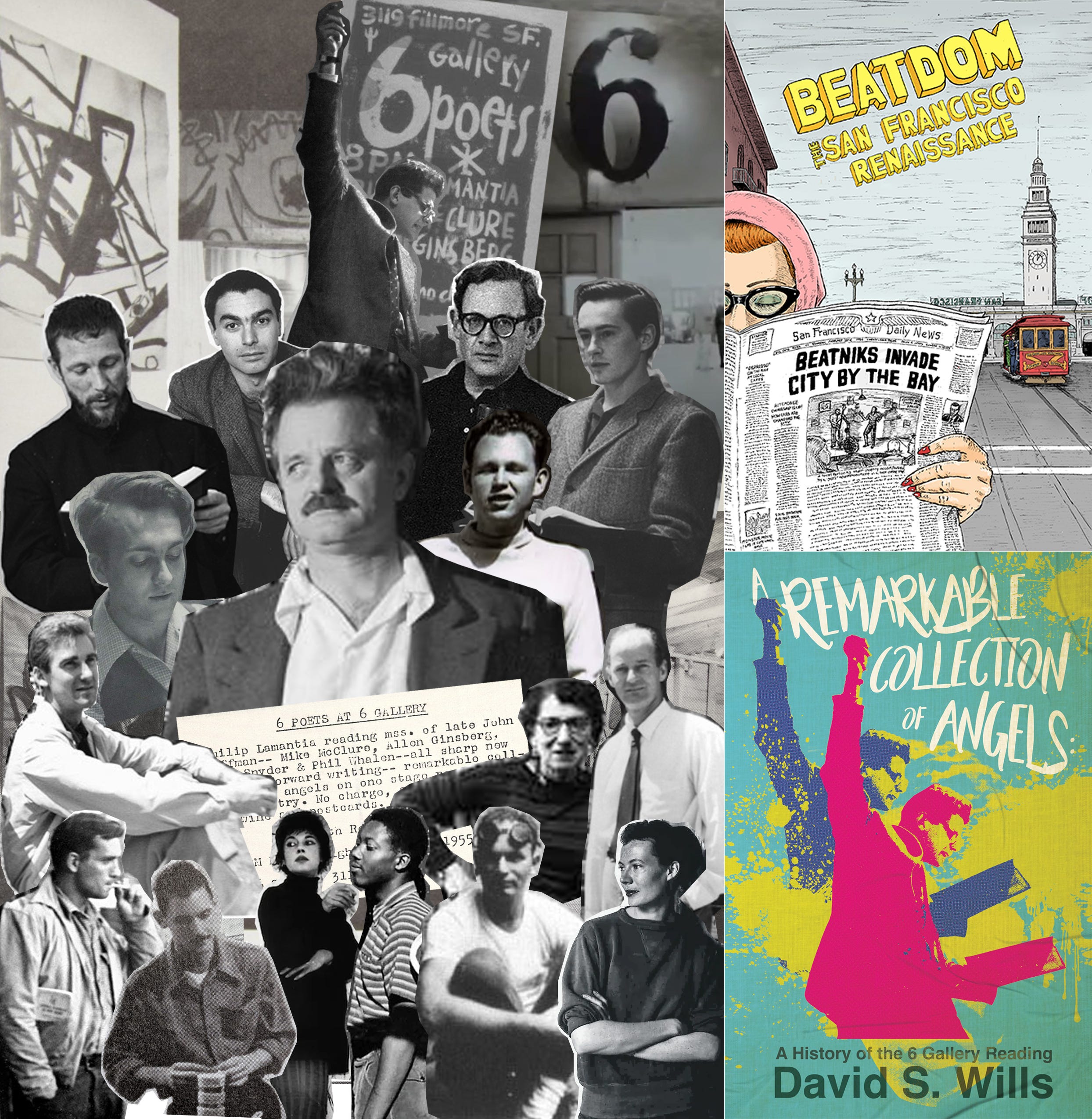
The Berkeley group mostly moved into San Francisco and pursued various artistic endeavours in the early fifties. Duncan, together with Jess Collins and Harry Jacobus, founded the King Ubu Gallery, which later became the 6 Gallery. This was named for the fact that there were six founding members, one of whom was Spicer, their teacher at the California School of Fine Arts. Spicer was partially responsible for the fact that the 6 Gallery hosted poetry readings, and he performed there on at least a few occasions soon after it opened. Duncan’s highly experimental play Faust Foutu was performed early in the gallery’s life, too. In the audience that night (January 20, 1955) was Allen Ginsberg, a newcomer to the West Coast.
Ginsberg had moved to San Francisco in 1954 and quickly met the various poets of the city. That included both Spicer and Duncan, neither of whom hated him at first but at the same time neither was particularly impressed. There is little information about how Ginsberg and Spicer met and Duncan and Ginsberg both had different recollections of their first meeting, but in any case Spicer and Duncan soon left the Bay Area. Duncan travelled to Spain and Spicer sought out better literary prospects on the East Coast.
It is ironic that Spicer pushed for the gallery to be a place of poetry and was then absent for what would become known as “the 6 Gallery reading.” In July 1955, he headed for the East Coast and it was around this time that Wally Hedrick asked Allen Ginsberg to arrange a series of poetry readings at the gallery. Ginsberg refused but in August he began writing “Howl” and soon “changed [his] fucking mind.”[i] The rest is history. Well, actually it was for 70 years mythology but now at least there is a history of it…
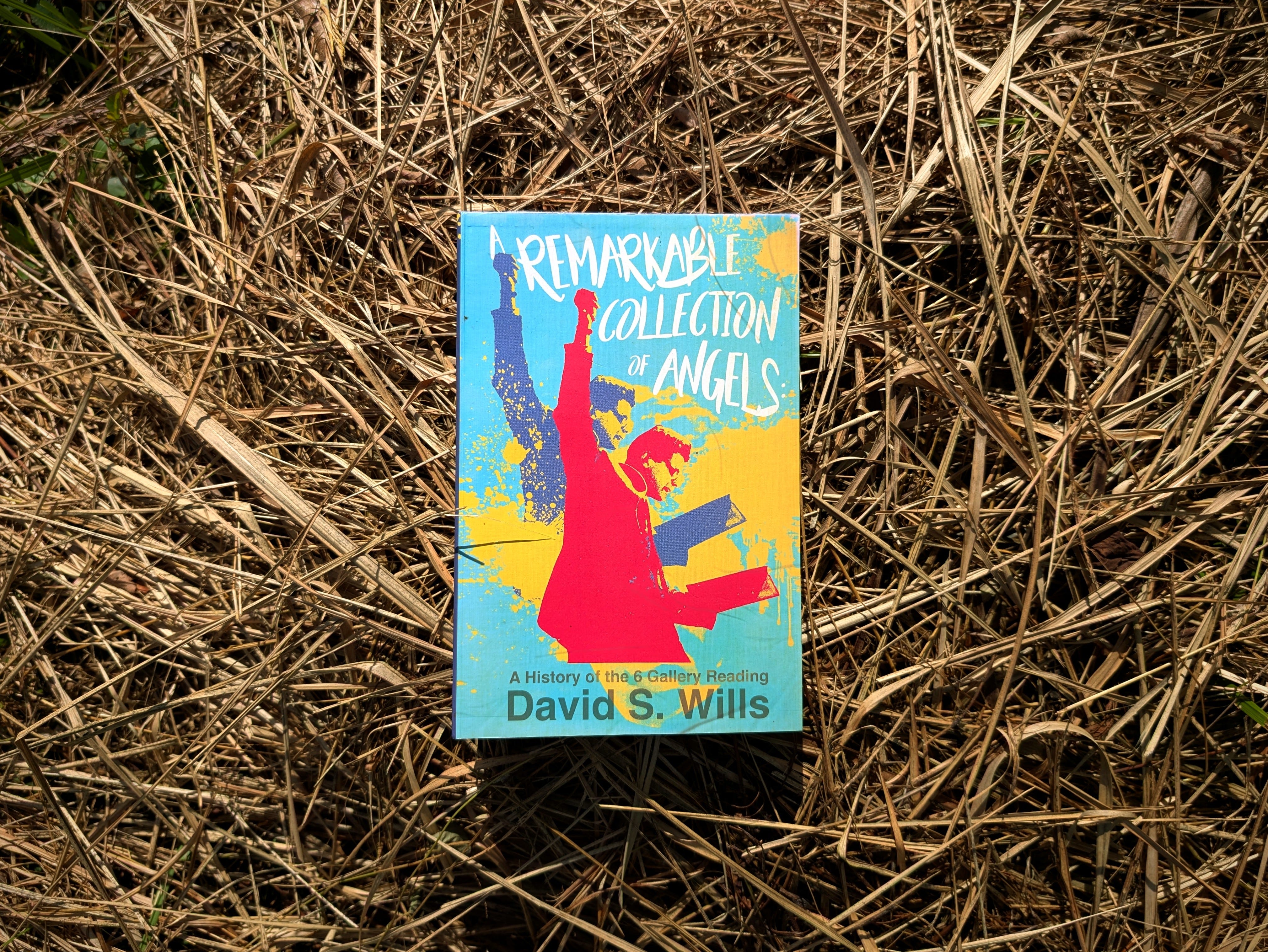
The 6 Gallery reading was a massive success in no small part due to Ginsberg’s reading of “Howl.” The raucous, intense, boozy event and the brazen, electrifying poetry read that night changed the whole scene. Yes, there had been poetry readings before, but this one was an unprecedented success. In the months following it, poets tried to emulate not only the excitement of the reading but the style of its most notable poem. All across San Francisco, bars and cafés began hosting readings of bohemian poetry, much of which included so-called obscene language. A follow-up event in Berkeley caused this cultural movement to achieve a critical mass and by the time Spicer and Duncan returned in 1956, they found a completely different city to the one they had left a year earlier.
Oddly enough, Spicer was involved in the second reading, but only because he had sent a letter to John Allen Ryan (another co-founder of the 6 Gallery), who passed it to Michael McClure to read to the very amused and somewhat inebriated audience. This is frequently said to have occurred at the 6 Gallery reading but it is just one of many myths. As best I can tell from an audio recording, the letter said:
You’re a great bastard. Your letters have disturbed my contentment. Here I am with an excellent job, writing well, handling the rare books etc. in a library in Harvard in Boston, lonely as a kangaroo in an aquarium, and then you have to write about how on the other side of the country people are really alive, thinking significantly, getting drunk significantly, fucking significantly. You’ve upset my cold New England dream world. In the words of Faust, you would never read to me, “Weh! Weh! /Du hast sie zerstört,/ Die schöne Welt.” There’s nothing here, just like there is nothing in New York. I’ve always said that the East was empty, but I’m surprised to find this is true as a literary anti-Semite like Duncan would be to find that the world was controlled by the Jews. There’s an isolation from dreaming, an isolation from magic, an isolation from enthusiasm. Nothing is left but manners and good will. New York lost even the good will. It is impossible to imagine how poisonous culture without enthusiasm can be, like a perpetual educational television program. Enough of this. I would leave for San Francisco tomorrow if it were not for the horror of unemployment that those fine shattering jobless months created. I cannot live without security anymore, any more than I can live without magic. I discovered that I don’t like people well enough to allow myself to be dependent on them. I would come back for any job, but it would have to be a job I came back to. So, Mr John Allen Ryan, if you love for me and have any friends that love me, start them searching for a place in San Francisco where I could be employed, anything from night-watchman in a museum to towel-boy in a Turkish bath. I won’t come back without a job to come back to, and I won’t stay here even though I love rare books, if I have a chance to come back to civilization. This is a manifesto as well as a personal letter, broadcast its terms. San Francisco has a chance to regain its second poet. The other poet, Dante, is also willing to return to Florence under conditions. My “Oliver Charming” is wonderful. I hope I’ll have a chance to show it to you personally. It’s long, incoherent and sexual. I think it’s the most important thing I’ve written, but, of course, it’s only half-finished and god knows…[1]
The audience’s response was very positive but no one found Spicer a job. The witty letter also hid the fact that he was very depressed and isolated on the East Coast and was upset about missing out on the excitement of the new scene. He had been given regular updates and no doubt hated to learn of Ginsberg’s growing success.
When Duncan moved back to San Francisco, he was shocked and disappointed by the changed scene. He later recalled:
Returning to the City after these events, we were in a sense objects of nostalgia from before. By the time we came back in ’56, it was really Allen Ginsberg’s city—Allen Ginsberg’s and Lawrence Ferlinghetti’s city.[ii]
Duncan and others called it “Ginsbergenlandt”;[iii] however, he came to appreciate Ginsberg as a person and as a poet. This was very different from Spicer, whose hatred only continued to grow. His biographer said that “[t]o some extent the remainder of Spicer’s career can be seen as a reaction to the behemoth that the event gave birth to.”
To be fair, there was a lot of hostility at the time. As the San Francisco Renaissance kicked off and a great many books and zines were printed, poetic rivalries developed or worsened. Cliques formed and artists began to realise—as Ginsberg had always known—that poets were more likely to succeed when they formed alliances. As opportunities arose, some felt overlooked or begrudged the attention given to those who were best at publicising themselves. Say what you want about Ginsberg’s talent, the man was unmatched in terms of self-promotion and this drew a lot of jealousy.
Although Spicer was almost certainly contemptuous and jealous of Ginsberg, he was introverted, alcoholic, self-destructive, and possessed a principled perspective on poetry that was perhaps admirable but ultimately doomed. Dora Dull explained:
he was always putting down Ferlinghetti for making money off poetry, and the rule was that one must never make a penny off poetry. That was a very strict rule. Yet, if you don’t, and if you want to spend your life writing poetry, then where the hell is the money going to come from? Because he couldn’t figure that one out, I think that’s what made him so angry and so crazy with people.[iv]
He was, in short, his own worst enemy. He was a gifted poet and a wonderful teacher, so many people put up with his endless bitching because they saw his positive qualities. But he was never willing to collaborate with those he did not like or respect, and that list was seemingly endless. He could have become a successful poet but sabotaged his own chances due to an unwillingness to be civil with the likes of Ginsberg and Ferlinghetti. He would not even let City Lights stock his books when he was finally published and irritated his publishers by pissing off other booksellers.
Even when well-meaning and well-respected people reached out to him or publicly flattered him, Spicer would return the favour with insults or yet more bitching. The great Ruth Witt-Diamant, founder of the San Francisco Poetry Center, suggested in 1960 that Spicer had surpassed Kenneth Rexroth (another person Spicer hated) as the most respected of the North Beach poets. Spicer fired off a missive to the Chronicle, saying, “I should like to take advantage of her mistaken generosity to protest both against Poetry Center and the alternative institutions she praises.” He viciously attacked her program as “a contest between college professor-poets bucking for assistant professorships and beat generation poets bucking for newspaper space,” adding that it was all “ghastly examples of the misuse of the human heart.”[v]
Instead of participating in the burgeoning poetry scene, he sat playing Scrabble at The Place and accumulated his own small following of poets, all the while telling those who listened just how much he hated the Beats. One of those poets was Richard Brautigan, who arrived in San Francisco shortly after the 6 Gallery reading and became part of the post-Beat and hippie scenes. He and Spicer got along very well, possibly because Brautigan was deferential to the older poet. In fact, Spicer was exactly ten years older. They shared a birthday, making today the 91st anniversary of Brautigan’s birth. Spicer was a keen astrologer and felt this was auspicious.
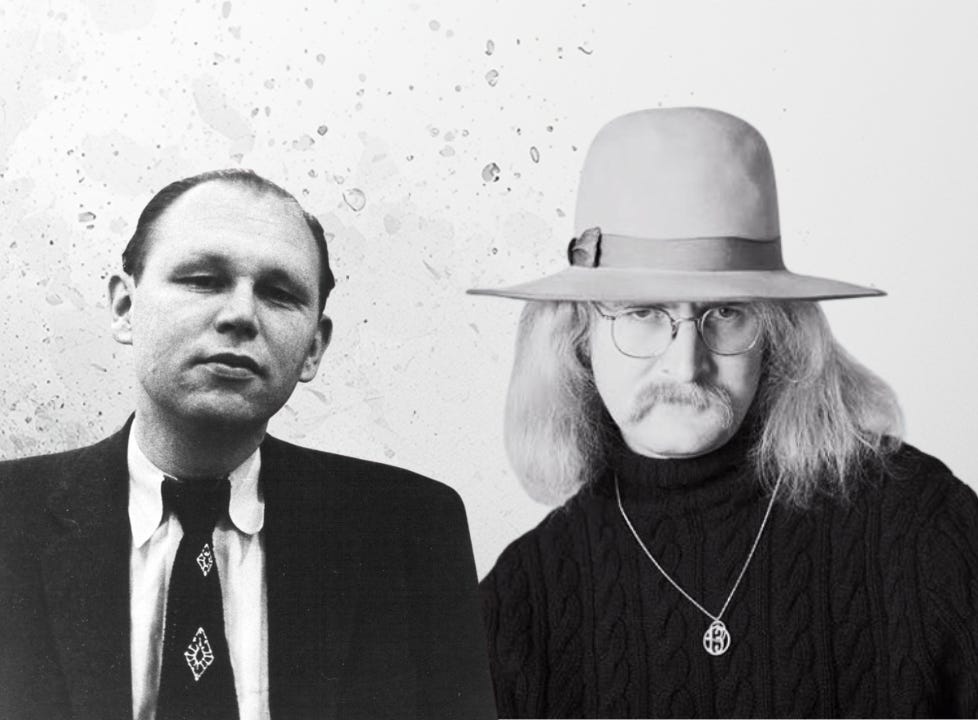
Brautigan also struggled to get along with Ginsberg but there seems to have been no real hatred. Ginsberg was sometimes nasty towards him but Brautigan did not respond. The Beat writers generally looked down on him to some extent and Ferlinghetti was perhaps the bitchiest here:
[Richard Brautigan] never could be an important writer like Hemingway. with that childlike perception of the world. The hippie cult was itself a childlike movement. I guess Richard was all the novelist the hippies needed. It was a nonliterate age.[vi]
I have written a longer essay about Brautigan and the Beats here. It details their various interactions and is largely based on the excellent biography, Jubilee Hitchhiker. Fans of Brautigan may also wish to read this essay about his influence on Japanese novelist Haruki Murakami, whose first two novel(la)s were hugely inspired by Brautigan.
Returning to Spicer, he would walk around North Beach screaming “FUCK GINSBERG,”[vii] according to John Allen Ryan, who was sexually involved with both Ginsberg and Spicer. (Perhaps there we might see another of the reasons for the hatred…) But it was not only drunken screaming into the night. Spicer wrote poems about how much he disliked Ferlinghetti and Ginsberg. He satirised Ferlinghetti’s jazz poetry sessions in a vicious poem titled “Ferlinghetti.” It begins:
Be bop de beep
They are asleep
There where they like us
It goes
From nose to nose[viii]
Then he added: “Ferlinghetti is a nonsense syllable invented by The Poet.” The authors of Spicer biography Poet Be Like God write:
This comment is striking not so much for its hostility to what Spicer took to be a minor poetic ability or for its distaste for an individual, as for the confidence behind the remark itself, the surety that he, Spicer, could make such a statement about a well-known contemporary: In such matters he was often fearless, perhaps foolhardy.[ix]
David Meltzer is quoted in the same biography as saying, “You couldn’t be in North Beach at that time and have any relationship with Jack […] without being caught in the barbed-wire flak of bitchery.”[x] That matches with almost everything I read about Spicer during my research for A Remarkable Collection of Angels and Beatdom #25: The San Francisco Renaissance Issue.
But Ferlinghetti, as we have seen with Brautigan, could be bitchy as well. When asked about the infamous put-down poem Spicer had published, Ferlinghetti said he’d never heard of it. To the authors of the above biography, he simply asked, “Why would anyone want to publish a biography of Spicer? He’s almost forgotten nowadays isn’t he?”[xi] Ouch.
After Ginsberg’s famous Indian trip (as well as a brief tour of Southeast Asia) and his time at the Vancouver Poetry Conference, he returned to San Francisco and decided to look up Jack Spicer. This would’ve been the latter half of 1963. There are differing accounts of this. Robin Blaser said:
Allen arrived at Jack’s table in Gino & Carlo’s Bar and said he’d come to save Jack’s soul. Jack replied that he’d better watch it or he’d become a cult leader rather than a poet.[xii]
Ginsberg mostly denied this but the essence was that their meeting did not go well. His version:
Basically I went there to kind of reconnect with him, because I respected him. I didn’t understand his poetry, but I understood his influence on a lot of young poets. I didn’t understand his circle at all. I Just wanted to be friendly and check in.[xiii]
It is sad but perhaps fitting that the very last poem in My Vocabulary Did This To Me: The Collected Poetry of Jack Spicer is aimed at Allen Ginsberg. Written just two years after their unfortunate meeting at Gino & Carlo’s, and shortly before Spicer’s alcoholic death at 40 years old, he lashed out as bitterly as ever and with a tinge of jealousy: “At least we both know how shitty the world is. You wearing a beard as a mask to disguise it. I wearing my tired smile.”[xiv] A reference to Ginsberg’s recently being declared the “King of May” shows that Spicer still kept up with news about his nemesis. He could not let go. He still hated the man who’d stolen his poetry scene a decade before.
Spicer claimed to live on a diet of whisky and peanut butter and this lifestyle caught up with him in 1965. He collapsed and was taken to the poverty ward of San Francisco General Hospital, where he spent several days in a coma. No one knew who he was until Robin Blaser found him there. “The doctor said he had about half a liver left,” according to Jack Goodwin.[xv] It then took him three weeks to die—almost as long as it took people to find the body of Richard Brautigan, some 16 years later, after he shot himself in a fit of depression.
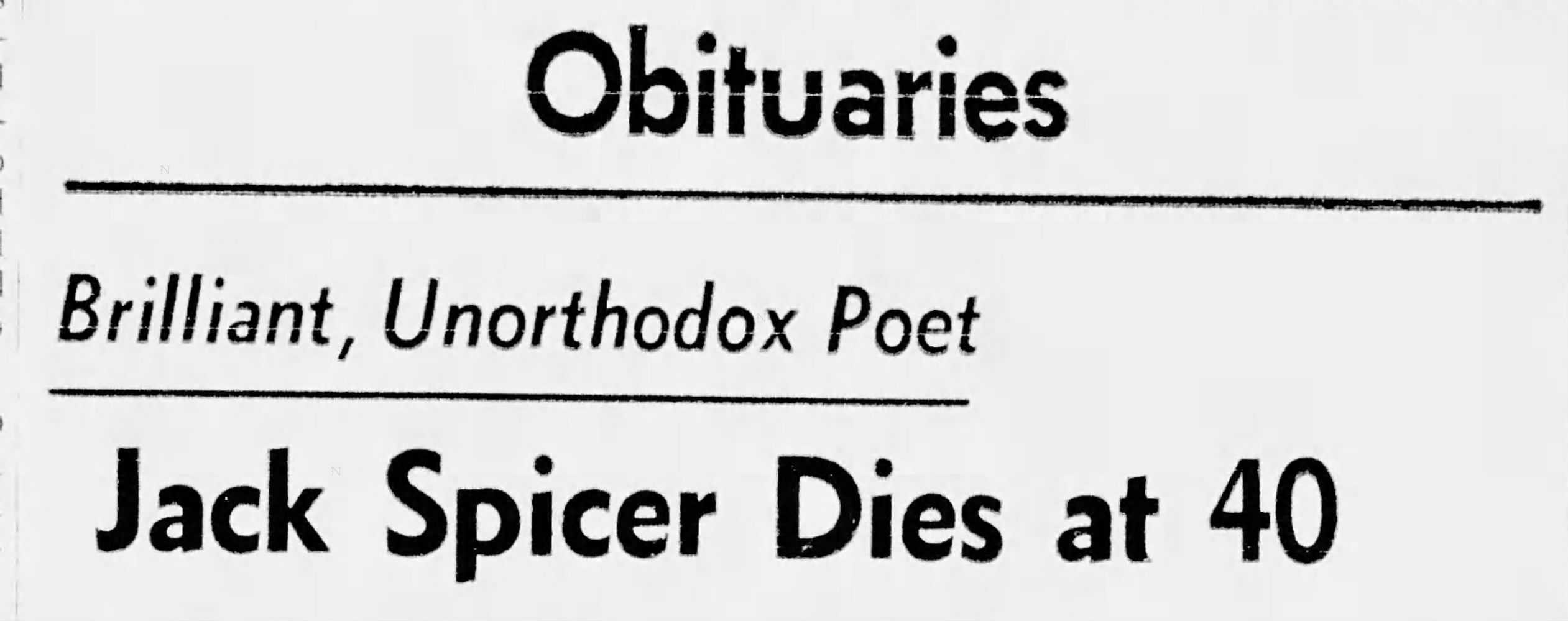
Not long before Spicer’s death, he granted an impromptu interview to the journalist Tove Neville. Noting that Spicer’s friends attributed his death to “estrangement,” Neville wrote: “It was a deeply felt collective estrangement from a society that has sold out its real values.”[xvi] I won’t do him the disservice of saying that rather accurate sentence qualifies him as a Beat writer for his overtly anti-Beat stance would make such a pronouncement absurd, but certainly there were a great many connections and not all of them were antagonistic.
Last year was Spicer’s centennial and it was heartening to see him remembered and I hope that this year sees a continuation of that.
Notes
[1] The recording can be found here: https://searchworks.stanford.edu/view/fg667wg6291 The Allen Ginsberg Project offered a transcription some years ago which differs a little from mine. There are a few places where McClure’s reading is unclear and he sort of trails off and at the end it’s not clear if he is withholding a line from the audience.
[i] The Letters of Allen Ginsberg, p.122
[ii] Poet Be Like God, p.78
[iii] An Open Map, p.101
[iv] Poet Be Like God, p.258
[v] San Francisco Chronicle, Feb 21, 1960
[vi] Contemporary Literary Criticism, p.316
[vii] John Allen Ryan to Allen Ginsberg, February 14, 1957
[viii] My Vocabulary Did This To Me, p.265
[ix] Poet Be Like God, p.192
[x] Poet Be Like God, p.289
[xi] Poet Be Like God, p.290
[xii] Poet Be Like God, p.277
[xiii] Poet Be Like God, p.277
[xiv] My Vocabulary Did This To Me, p.426
[xv] Jack Goodwin to Lew Ellingham, May 12, 1982
[xvi] San Francisco Chronicle, Aug 29, 1965
The comments towards Brautigan were ridiculous honestly. He was never really spiteful to anyone. Just a weird guy who wrote what he wanted for himself. I can't say exactly the same for some of these guys.
Thsi really nails how much literary scenes depend on who shows up when. That detail about Spicer being gone during the Six Gallery reading is almost Shakespearean in its timing. The jealousy angle makes total sense when you realize Ginsberg didn't just steal attention he fundamentally changed what kind of poetry got amplified in that moment. I've seen similar dynamics in smaller creative communities where someone's marketing instincts end up mattering more than the work itself, and it creates this weird resentment thats both justified and petty at once.