
Dreaming, Howling, Naming
How a single dream resulted in numerous important poems by Allen Ginsberg.

Seventy years ago today, Allen Ginsberg had a dream of such importance that it ended a brief period of writer’s block, lifted him out of a particularly deep depressive state, and ultimately resulted in a number of poems, with “Howl” being the most consequential.
The following essay builds upon one I published last June, “First Draft, Best Draft,” which aimed to correct certain mistakes people have made in discussing the composition of “Howl” and, most importantly, it dated the first draft of that poem, placing it about two weeks earlier than previously thought. It also demonstrated that “Howl” emerged from Ginsberg’s efforts to write a poem about a dream he had on June 8, 1955.
I started this essay a week after publishing the first one but it proved so complex that it has taken almost a year to write. Admittedly, I have not devoted that whole year to this one essay, but certainly it has taken an inordinate amount of time to piece this together. I suspect also that the resulting essay may prove rather challenging, but over the past week I have re-written it several times to simplify it and so I hope it is intelligible. It is rather long (at again more than 10,000 words) and it was hard to avoid jumping around in time and referring to multiple versions of multiple poems. I also stumbled upon some essential information at the last minute (literally this morning) and that required a hasty rewriting of certain parts, so I hope I have not made too many typos during these frantic changes.
As always, I will also use chapter headings to break up the text so that people can more easily digest the material and perhaps later refer to parts of particular interest. Although it may not be terribly intuitive or obvious, there is a small panel on the left of this screen (at least when viewed on a computer) that when clicked should display a table of contents for navigational purposes.
Dreaming
On June 8, 1955, Allen Ginsberg was in bed with John Allen Ryan, a young painter and poet who was one of the six founders of the 6 Gallery[1] in San Francisco. That night, Ginsberg dreamt about Joan Vollmer, an old friend from New York, who had died in a tragic accident in Mexico in 1951. The two had been close and he had visited her shortly before her death. This dream would become an obsession for him over the coming months and he would ultimately turn it into a successful poem: “Dream Record: June 8, 1955.”
This is probably not new information for those who know a lot about Ginsberg’s life, for it is mentioned in many books about him. However, there is much missing from those accounts. For one thing, Ginsberg explained a week later that the goal he had with this poem had not emerged from the dream but rather had come to him on June 3. He wrote to Kenneth Rexroth:
it has occupied my thoughts since June 3 my 29th birthday, culminating in in the dream, seems to be key to a poetry with a more holy inner structure than the random sketching of images I have been doing.[i]
In any case, the dream proved to be of monumental importance. He wrote about it sometime later in his journal in an entry beginning:
I dreamed this during a drunken night in my house when I brought home John R. and we lay peacefully at a late hour in each other’s arms asleep: I was visiting [St. Louis, a new city][2] big city, and there saw Joan Burroughs who has been dead now five[3] years— she sat in a chair in a garden with the smile on her face: restored to its former beauty, the sweetness of intelligence which I eternalized in my imagination, that had been lost thru years of Tequila in Mexico City, for Tequila had ruined her face & beauty before the bullet in her brow.[ii]
The passage goes on to detail his dream meeting with Joan, with whom he has a conversation that is essentially two old friends catching up. It just so happens one of them has been dead for several years. They discuss the following people: John Kingsland, William S. Burroughs, Jack Kerouac, and Lucien Carr. Joan wants to know how they are doing whilst Ginsberg is curious what she and other dead people know about the living. “Do the dead have memory, still love their mortal acquaintances, & do they still remember us?”[iii] he asks, but she fades away before she can reply. Ginsberg is left standing before her grave.
He would later turn this journal entry into a poem called “Dream Record: June 8, 1955.” However, it was not a simple process. He did not merely pick words and images from his dream and then add a few line breaks. As we shall see, he struggled for some time with the problem of accurately conveying the “sensations” of his dream. Whilst he did manage to write a good version of the poem, upon which only relatively minor changes would later be made, in the space of a few days, he continued to tinker with it and seek feedback from friends for several months.
It is also important that he did not simply write this journal entry in a spontaneous fashion and without revision, later adapting it into poetic form. I think Ginsberg knew as he wrote that it was important because more than any other passage in his journal from this period, it is heavily edited. The dream record takes up a little over one page in his journal (others usually took up a quarter or half a page at most) and yet he has scored out more than two dozen words or phrases and changed them. Mostly these are minor details, such as prepositions and conjunctions; however, longer sections are more heavily scored and harder to read. Word choice was clearly a concern as in several places he has picked multiple words and did not score one out, unsure for example whether to say that Joan “faded” or “vanished” towards the end of the dream.[4]
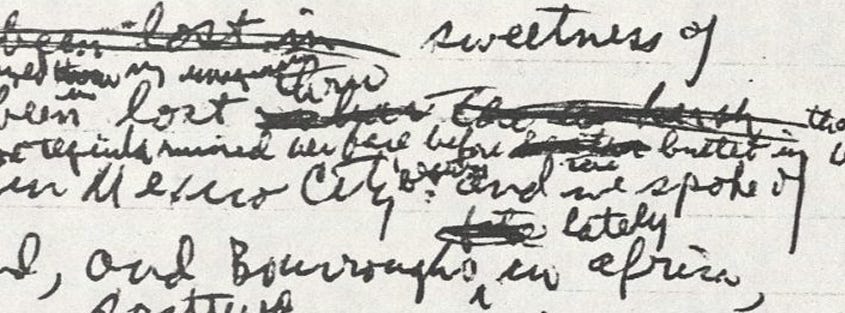
Why is this important? It clearly demonstrates that Ginsberg not only saw his dream as possessing interesting images worthy of remembering, but that there was real poetic potential here. If he was merely recording a dream, why would he care so much about the specific wording? It seems obvious to me that he wrote it down with every intention of turning it into a poem, and that seems even more likely considering the above-quoted remark to Rexroth about certain poetic inquiries “culminating in in the dream” rather than—as one might assume—the opposite occurring, which is to say the dream inspiring these poetic ideas.
Soon after writing his dream record, Ginsberg began making notes about how to turn it into a poem. He often did this, putting his poetic ideas into written words presumably for his own later reference or perhaps just working through ideas on paper so that he better understood his own mind. In his journal, he wrote:
The poem as an equation (a machine), reproducing in verbal images the visual & other images of the dream of Joan—reproducing the elements which juxtaposed gave me the awe & terror & knowledge in the dream—Successfully such an ideal poem could reproduce that ‘‘petite sensation”’ in the reader.
[…]
What is needed in a poem is a structure (magical, miracles in the head) of clear rational actualities put next to one another to suggest (in the eclipse of Time between the images) Eternity. The “intervals.’’ The gap of time. Joan’s live body—Joan’s tombstone.[iv]
He then looked at successful examples (Eliot, Crane, Keats, Williams,[5] Pound) of juxtaposition of images. He would most famously achieve this himself in “Howl” with the phrase “hydrogen jukebox,” something he repeatedly explained when teaching poetry. However, he struggled because
The dream presented a perfect structure to me by my unconscious—can one be synthesized consciously?[v]
Ginsberg’s notes were frustratingly undated and later in that month he started using incorrect dates, making matters more confusing.[6] We will look at this further in the following section but for now let’s compare Ginsberg’s initial journal entry with the resulting poem. For copyright reasons, I will limit this comparison to a few lines from the start of the poem:
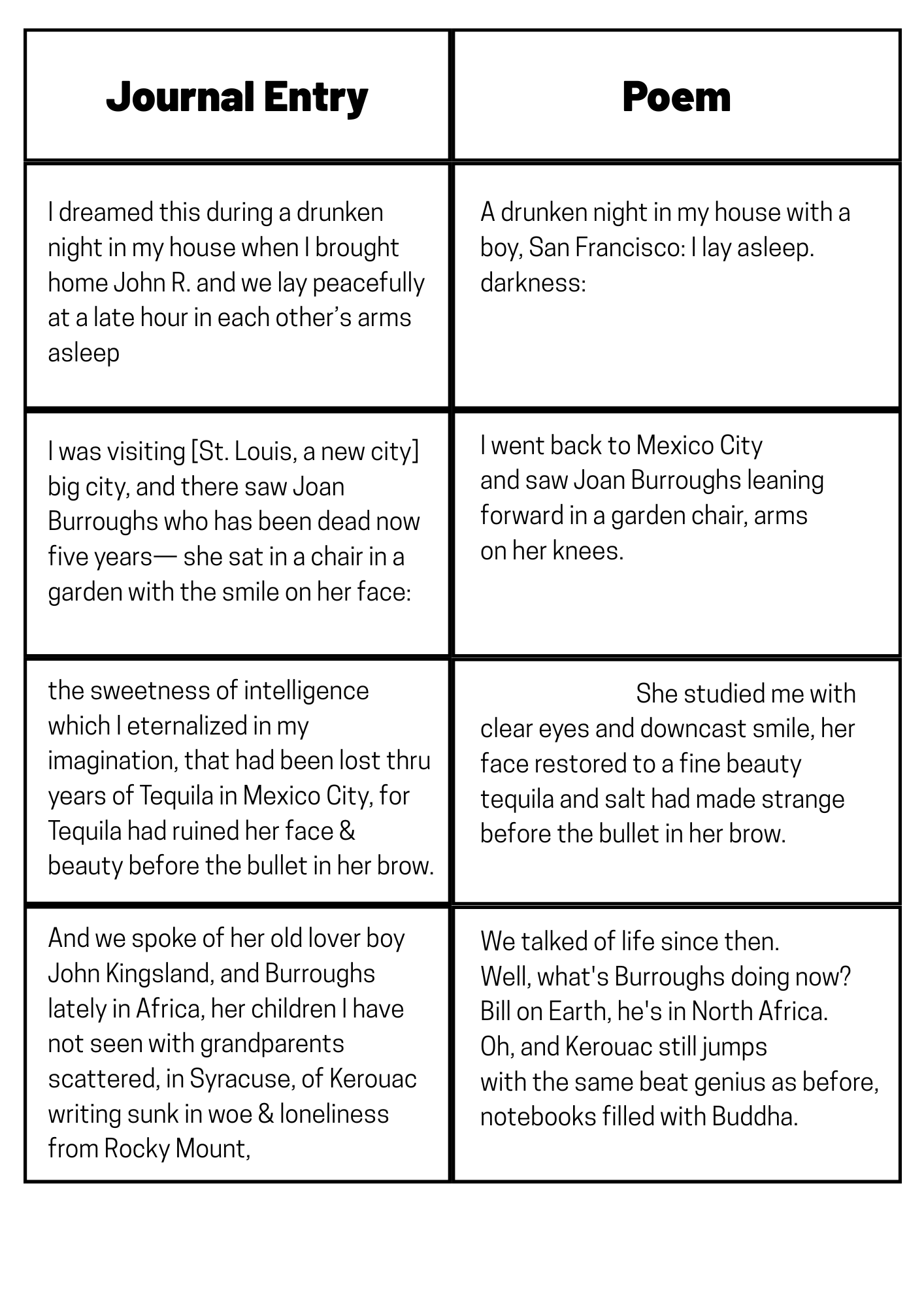
Most obviously, he has abbreviated his language to omit what he later called “syntactical fat,” exposing the “mind-meat.”[vi] In the first line alone we can see how effective this was:
I dreamed this during a drunken night in my house when I brought home John R. and we lay peacefully at a late hour[vii]
Became:
A drunken night in my house with a
boy, San Francisco: I lay asleep.
darkness:[viii]
The changes are greater than merely removing superfluous words. He has reduced much but he has also expanded other parts and clarified or changed details. In spite of feeling that he needed to convey the “perfect structure [presented] to [him] by [his] unconscious,” he made more substantial changes that did in fact alter the structure. His dream began in St. Louis but ended in Mexico City, and perhaps whilst this sort of switching/morphing of locations is common in dreams, he felt the Mexico City location was more significant for a poem, so he says in the poem that the whole dream took place there.
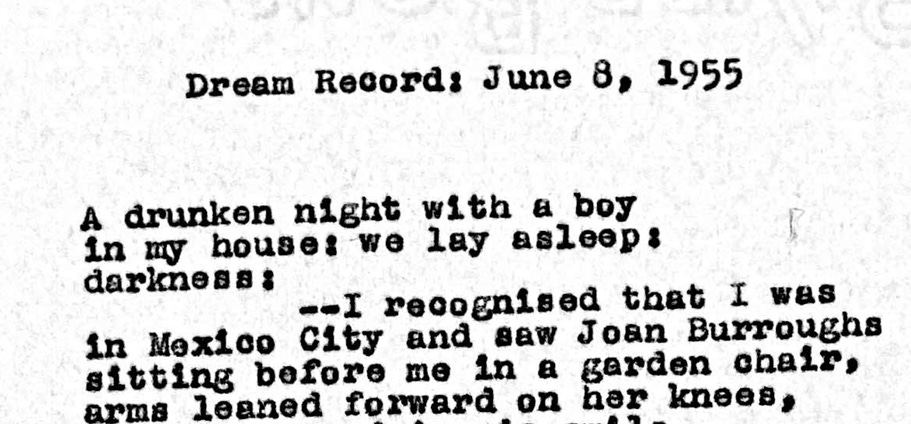
If we look at an early effort at the poem, which falls between the journal entry and the published version, we can see that even minor changes had significant poetic impact. For example, on the subject of changing St. Louis to Mexico City, he initially poeticised the line as:
I recognized that I was
in Mexico City
This later became:
I went back to Mexico City
We can see from his notes and letters that he was determined to convey the sensation of a dream and so he has changed this line to evoke that sensation of actually travelling somewhere rather than the more conscious intellectual experience of “recognizing.”
There are many more changes. He has changed John Allen Ryan into “a boy,” possibly to avoid embarrassing him and John Kingsland has been removed entirely, whilst Herbert Huncke has been added. Similarly, he completely rewrote a reference to Lucien Carr, ostensibly to hide his identity but at the same time his changes made the reference more obvious.
The Carr reference is worth looking at in more detail because it is the part of the poem he changed the most. In his journal entry, he wrote:
[…] and Lucien whose mute smile and guarded eyes in photo look down on me as I write this […][ix]
In Journals Mid-Fifties, Lucien” was changed to “Joe Army,”[x] a pseudonym Ginsberg used for him in some poems. He had other names for his friend, including Claude, which he used in letters to Kerouac, and below we can see a third: Kenney. In “Dream Record: June 8, 1955,” he wrote:
And how is Kenney? Married, drunk
and golden in the East.[xi]
No quotation marks are used but the question is spoken by the ghost of Joan and the response is Ginsberg’s. This change offers a small clue as to when Ginsberg wrote his poem, as we shall see in the next section…
Dating
When thinking about this poem, we should ask three questions:
When did he have the dream?
When did he write the record of it in his journal?
When did he write the poem “Dream Record: June 8, 1955”?
The first two questions are not terribly important but the third is and it relates to the first, so we should explore all of them to some extent.
Let’s start by looking at his journal from that year. Frustratingly, he was writing in a 1952-1953 journal even though it was 1955, and for some reason he did not bother to date most of his entries. The dates that do exist are not hugely helpful either because he often got them wrong, making it seem as though he was picking his journal up and writing on a nearby blank page rather than working his way through the book one page after another. (In fact, he quite possibly did this with certain entries.) His handwriting is also so atrocious that I’ve honestly spent several hours looking at single sentences, just trying to figure out what the hell he was saying.
On one page,[7] he began the dream notation that would eventually become “Dream Record: June 8, 1955.” It appears to say that the entry was written on June 8, but actually the text reads “From Reality Sand dated June 8, 55.” Reality Sandwiches was published in 1963, so clearly this note was added later. Thus, it should not be trusted as an accurate date for the journal entry.
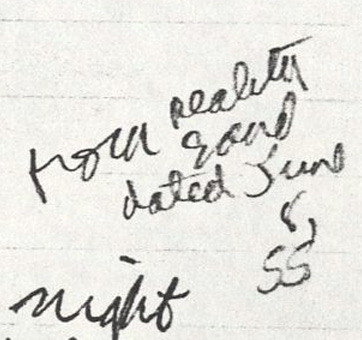
If we again return to its first line, we can see it is uncertain when the text was written:
I dreamed this during a drunken night in my house when I brought home John R. and we lay peacefully at a late hour in each other’s arms asleep
It sounds as though he is recalling this a few days later. Normally, when he awoke and wrote about a dream, he simply launched into a description of it. If he wrote it the next morning, he usually said so. (Indeed, in late May, he was mostly writing his dreams the following morning, writing things like “The dream of last night recalled still only in fragments…”) However, the above introductory sentence hints at the passage of time, as do several follow-up lines about other dreams from previous days. He then writes that he went to a garden at the California School of Fine Arts campus,[8] where he read Plato. It is impossible to say for certain, but it appears this whole passage—the dream, the earlier dreams, and reading Plato—was written at the same time. In other words, he did not write the dream record immediately upon waking up.
Thankfully, after almost a year of unnecessary research and speculation, I found a letter that showed June 8 quite possibly the right date. Ginsberg had written his poem with the date in the title by June 13 (and likely the day before), so in spite of often later getting dates and chronology wrong, he was almost certainly correct here—the dream probably occurred on June 8. (Unless of course he went to bed on June 8 and woke in the wee hours of June 9, but that’s perhaps being overly pedantic.)
Given that he probably had the dream on June 8 and seems to have written the poem by June 13 (but more likely June 12), then he probably wrote his notes and worked on the poem between June 9 and 12 or 13. It seems that this was a quite substantial effort for he did not only extensively edit his journal entry but followed it with six full pages of handwritten notes discussing poetic possibilities and problems. He also, on June 14 or 15, wrote two more pages rehashing and expanding these ideas in a letter to Rexroth. These notes are clearly the result of much thought and some research for they go into huge detail and cite specific lines from certain poems and also discuss how to convert to poetic form the painting techniques of Paul Cézanne.
For a long time, I believed Ginsberg worked on these notes throughout the summer, perhaps writing early versions of “Dream Record: June 8, 1955” that were quite different from the final version but in fact the version of the poem he sent to Rexroth on June 15 is quite close to the final draft. Yes, there were many small changes made later, but I must emphasise the word “small.” That is not to say that they are inconsequential because these changes served important functions but the poem he sent Rexroth is recognisable and the changes require close scrutiny in order to discover them.
To some extent, Ginsberg continued the process of paring down his language, removing unnecessary words to make the remaining words provide more impact. However, he removed ideas too. In his journal entry, he referred to Joan’s children and in the first poem he named one, Julie. There was no mention of any children in the published version. In the journal she does not ask after Ginsberg but in the first poem she does and he responds, “I got tired of San Francisco.” This is changed, in the published version, to say he has “[n]ew loves in the West.” This is interesting because in the first half of 1955 Ginsberg was actually quite down on San Francisco and it was only after this dream and his poetic breakthroughs that he began to see the city as a vibrant place.
On the next page in his journal, he notes another dream dated July 22… but importantly this is a mistake and he meant June 22.[9] His journal then details various dreams and thoughts and events from July, then August and September, returning to August again, when he returned to the idea of his Joan dream poem:
Note: For Joan Dream. “What consciousness in oblivion?”[xii]
More undated dreams and poems followed before he wrote the following lines, the first of which should be immediately familiar:
I saw the best mind angel-headed hipsters damned.
What consciousness in oblivion, Joan?[xiii]
This was, of course, the first version of the first line of “Howl,” which he began at some point between August 7 and 10. This is something that confused me for a long time and which ultimately pushed me to spend nearly a year writing this essay. I was not sure which of the following two options was correct:
Ginsberg wrote “Dream Record: June 8, 1955” in June and then noted down the first line of “Howl,” returning to it two months later to write the first draft of the poem.
He worked on his “Dream Record: June 8, 1955” poem throughout the whole summer, then stumbled upon the first line of “Howl” and shifted his energies to that work.
There were clues in his journals and correspondence but from these I could only speculate. The journals, as I’ve said, are a nightmare in terms of dating entries and I still cannot say for sure that he didn’t simply open his notebook at a random page to write down the above “I saw the best mind…” line when it came to him, then later filled in the other pages. From his correspondence, we certainly know that he had some sort of poem or poems about his dream of Joan and that he had written at least one in June. Alas, some letters have been lost or in some cases part of them have been lost. Still, we can use what we have to provide a few important details.
On June 15, Ginsberg wrote to Kenneth Rexroth asking for advice on a poem about a dream. He said he had visited two days earlier but Rexroth had not been home because he was on a trip. That means Ginsberg had started his poem before June 13. He wrote:
I tried here to recreate the sensation I experienced in the dream in the interval between the last question and the symbolic answer, but I am not sure that the parts are visually clear enough & the transition swift & as relevant to others as to myself. A question here as I’ve never encountered before of dealing with a precision science in my own writing to actually attain a shock, thru the telescoping of time—make a machine of poem which might actually reproduce the “petit sensation” in the reader. But having revised and tried to sharpen the images for several days I no longer can recognise whether it is successful in attaining for an outside eye the inner secret time shock […][xiv]
He goes on to cite successful examples by Rexroth as well as repeating some of his concerns and interests from his journal (Crane, Cezanne, Pound, etc.).
Alongside that letter, Ginsberg attached a version of “Dream Record: June 8, 1955.” It had the same title and, as I’ve said, it is very similar to the final version albeit with a number of small changes.
Ginsberg also sent his poem to Jack Kerouac.[10] Kerouac lost Ginsberg’s letter but we have his response and then follow-ups by Ginsberg. This exchange shows that Ginsberg had sent a copy to Kerouac in mid-June, probably a little after sending it to Rexroth. On June 29, Kerouac responded:
I got your dream about Joan, and Lucien [Carr] and I discussed it and got to talkin about Mexico your trip there.[xv]
Although Kerouac does not mention the “dream about Joan” being a poem, thus raising the possibility that Ginsberg had merely explained the dream in a letter, a July 5 reply by Ginsberg confirms it to have been a poetic account:
What did Lucien say about Joan poem dream? I wasn’t being mad at him I was saying your father in laws moustache via that paragraph I did hope he’d be impressed by theory.[xvi]
Whilst on the one hand this shows that Ginsberg had sent a draft to Kerouac (and Carr), and we know from his Rexroth letter that he had a pretty good draft finalised by the time he sent his letter, it is rather confusing that Ginsberg is worried about having offended Carr. There are other comments in their correspondence that indicate a minor fallout between them as a result of something Ginsberg had written.
The most logical assumption is that Carr disliked being named in a poem. Above, I quoted the published version of the poem as saying:
And how is Kenney? Married, drunk
and golden in the East.
However, “Kenney” was a pseudonym added prior to publication and the manuscript version used “Lucien.”[11] Carr may have been annoyed about Ginsberg for mentioning him explicitly in a poem. After killing David Kammerer and serving time in prison, he wanted to stay out of trouble and he urged his Beat friends not to mention in print. In the summer of 1955, his wife Francesca “Cessa” von Hartz was pregnant with their second child (the late novelist Caleb Carr) and so Lucien would have been particularly eager to avoid unwanted attention.
It is also possible that Carr was annoyed with Ginsberg over something mentioned in a letter accompanying the poem, but Kerouac lost the letter. Cryptic mentions are made of Carr being “frightened of science”[xvii] and perhaps Ginsberg had said something critical that Carr saw in the letter to Kerouac, but we cannot know for sure. This would make sense given Ginsberg’s use of “paragraph,” but sometimes he referred to stanzas as paragraphs.[12] Besides, Kerouac seems to suggest that it was more related to the poem in a follow-up letter sent on July 15:
About Joan poem dream Lucien didn't see it, I forgot it here, then later he saw it in your letter but by then you'd dubbed him “drunk and golden” instead of just golden and anyway I wasn’t there when he read it so no comment—generally I would say that Lucien loves you and considers you a charitable saint . . . don’t get so hungup on what he thinks[xviii]
This is a bit confusing because originally Kerouac had written “I got your dream about Joan, and Lucien and I discussed it,” suggesting Carr had seen the poem, but now he says “Lucien didn’t see it.” Perhaps Kerouac had merely mentioned it, bringing about their discussion. But what is of more interest is the possibility that Ginsberg had by mid-July sent two versions of his poem. Pay attention to the following words from Kerouac’s letter:
[…] Lucien didn't see it, I forgot it here, then later he saw it in your letter but by then you'd dubbed him “drunk and golden” instead of just golden […]
It seems that there was a version of the poem that called Lucien “golden” and a later one that called him “drunk and golden.” Ginsberg may have sent a poem at some point prior to June 28 and a revised version later, possibly attached to his July 5 letter. This would certainly hold with the notes in his journal, which show that the poem did not come together easily and was worked on over an extended period.
Ginsberg edited and rewrote his poems to varying degrees, so it would be not surprising if he sent two versions. However, there was no mention of Lucien being “golden” in his journal entry, and even by the draft of “Dream Record: June 8, 1955” that he had written on what I estimate as June 13 at the latest, he had already written “drunk / and golden in the East.” Could there have been another version between the journal and poem? Had Ginsberg sent this to Kerouac and then sent one closer to the version he also sent Rexroth?
That may seem unlikely until we look back at Ginsberg's cryptic line quoted above:
I wasn’t being mad at him I was saying your father in laws moustache via that paragraph
What could this possibly refer to? I have no doubt that it referred to Lucien’s father-in-law, Ernest von Hartz—the news editor of the New York Times—who is shown in photos to have had a moustache. Ginsberg had been at Carr’s wedding and had written to Kerouac soon after that Carr and “old Von Harz (sic)” got along well. He’d also sent at least one letter to von Hartz from Mexico during his time with Karena Shields.
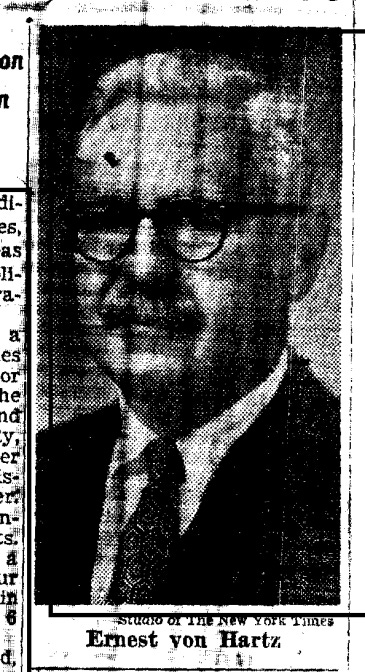
So, did Ginsberg say something rude about von Hartz (or his mustache) in a lost letter or did he insult the old man somehow in a poem that was also sent to Kerouac? The former is certainly more likely, yet perhaps that letter was linked to another poem written in 1955… This may seem like an outrageous tangent to follow but there is a poem from that period which explicitly mentions Ginsberg’s dream of Joan Vollmer, talks about Lucien Carr and the death of David Kammerer, and appears to refer to Carr’s father-in-law. This poem is “The Names,” erroneously dated to 1958 and only published in 1966. What few seem to realise, though, is that it was actually written in 1955 during or possibly even before the writing of “Howl.”
Naming
Permit me to engage in some wild speculation for a moment… We know that Lucien Carr seems to have been upset at Ginsberg and that this likely came as a response to something Ginsberg wrote in a poem that was ostensibly about his Joan dream. What if there was a draft of a poem that he sent Kerouac that was not what we might think of as “Dream Record: June 8, 1955”? What if it was an alternate version? What if perhaps it was inspired by Rexroth’s admonishment of the poem he had submitted? What if perhaps Ginsberg was inspired by an event that occurred between his dream and contacting Rexroth—an event he may not have heard about until the middle of the month?
It is possible that Ginsberg submitted to Kerouac in one of his June letters an early version of “The Names” or perhaps in the lost letter discussed ideas and played with lines that would later appear in that poem. “The Names” includes an eight-line stanza all about his Joan dream that not only refers to it but takes language and images directly from his journal entry. Its references to Lucien are more likely to have offended than those in “Dream Record: June 8, 1995” and there is arguably a reference to Carr’s father-in-law.
In the published version of “The Names” (at least as it appears in Collected Poems), Ginsberg begins by lamenting the fate of Herbert Huncke. After a few lines, he writes:
I'll answer for you Huncke I never could before — admiring your natural tact and charm and irony — now sad Sing Sing
whatever inept Queens burglary you goofed again let God judge his sacred case
rather than mustached Time Judge steal a dirty photograph of your soul — I knew you when[xix]
We can see the phrase “mustached Time Judge” but still the meaning is far from obvious, particularly when that person has stolen “a dirty photograph of [Huncke’s] soul.” Earlier in that stanza, Ginsberg refers to his own arrest—alongside Huncke and two other criminals—in 1949. In the news reports I managed to find in digitised archives, there are photos of the other two criminals (Jack Melodia/Melody and Priscila Arminger) and from Ginsberg’s poem, it appears that another photo existed showing Herbert Huncke. He calls it a “bestial newsprint photograph we shared once busted, me scared of black eye cops Manhattan.”
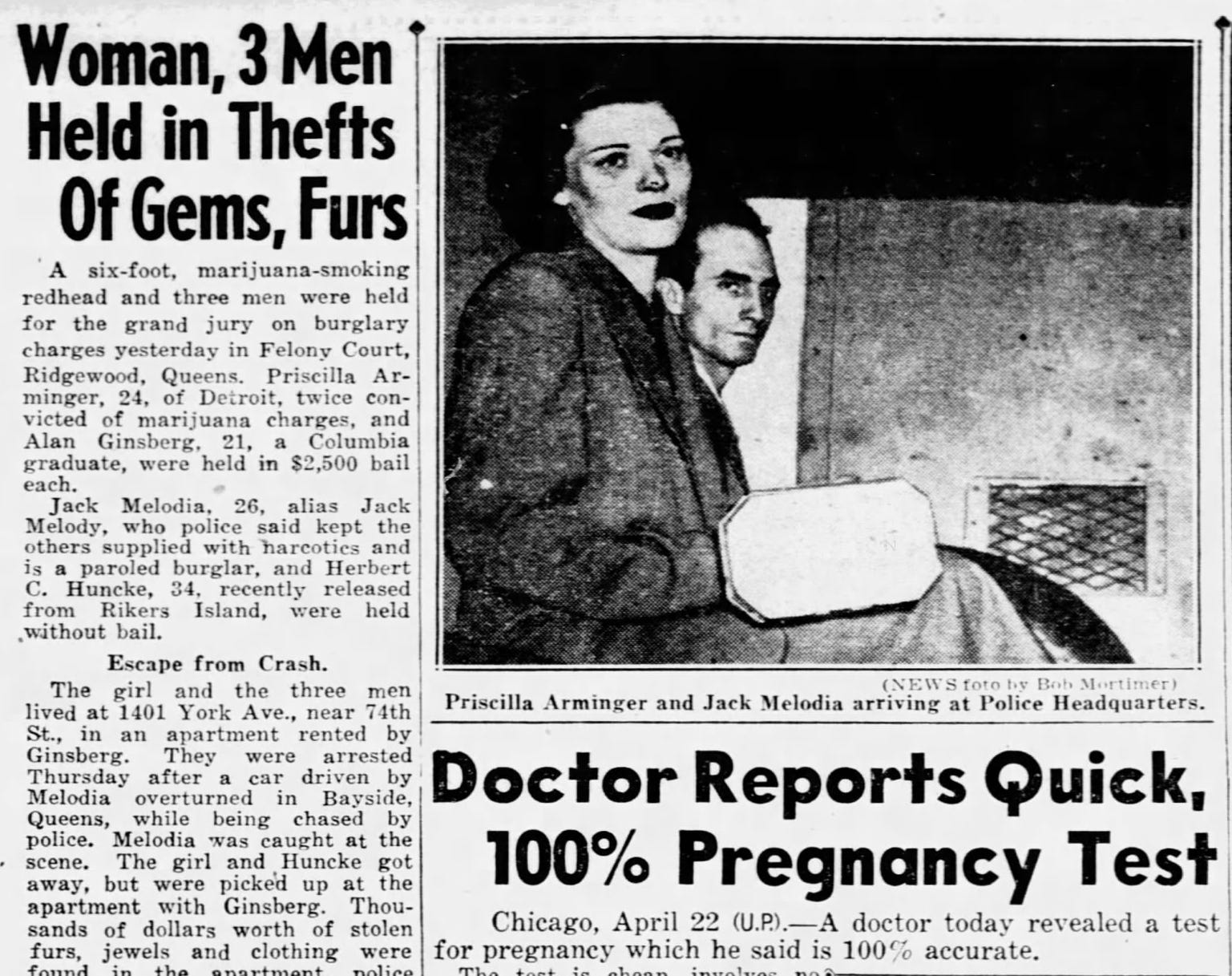
On June 11, 1955, Herbert Huncke was arrested after being shot at by New York police officers and, due to his extensive criminal record, he was refused bail and sent to “sad Sing Sing.” Perhaps Huncke was photographed again… or perhaps Ginsberg worried that he would be… or perhaps Ginsberg thought the old 1949 photo of them might re-surface. If such a photo existed, would Lucien’s moustached father-in-law profit from it? After all, he was news editor of the New York Times. The 1949 arrest had been covered in the press, including in the New York Times, where the headline was:
WRONG-WAY TURN CLEARS UP ROBBERY; Four Men and Girl Arrested -- Copy Boy Joined Gang to Get 'Realism' for Story[xx]
However, there was no photo of Ginsberg or Huncke attached to this particular article. Perhaps one appeared in another newspaper whose archives are not quite so accessible.
Picking apart the meaning of Ginsberg’s poem is tricky, but regardless of whether or not this line was the offending item, I think my theory still holds. After all, Herbert Huncke did not appear in the original dream of Joan, but he re-entered Ginsberg’s consciousness a few days later after his arrest and would eventually end up in both “Dream Record: June 8, 1955” and “The Names.” The former is quite surprising. Mostly, Ginsberg pared down his journal entry, removing words and images and names… but Huncke was an addition.[13] His arrest came on June 11 and Ginsberg wrote in his first version of “Dream Record: June 8, 1955”:
Is Huncke still in the can? No,
last I saw him, on Times Square.[xxi]
More than likely as Ginsberg wrote the poem, Ginsberg was in fact “in the can.” He would’ve heard about this a few days later but already the idea was in his head to write about his old friends—to tell their stories and celebrate their individuality and rebellion. He did this in “Howl,” of course, but he also did it in “The Names,” which can be seen as an amalgam of the concepts of “Howl” and “Dream Record: June 8, 1955,” and which was quite possibly written between them or at the very least attempted to combine their two primary themes.
The textual history of “The Names” is long and complicated and filled with uncertain dates. However, in each version of it, Ginsberg starts by celebrating Herbert Huncke, then moves on to his other friends. In an early draft of this poem, he writes about the following in this order:
Herbert Huncke
David Kammerer
Lucien Carr
Phil White
Hal Chase
Carl Solomon
Joan Vollmer
Bill Cannastra
Neal Cassady
Allen Ginsberg
He follows some of these names with “unless I save him/her from the grave” and then ends by saving himself, the idea being that he is poetically acknowledging and celebrating them, thereby immortalising them in spite of their suffering at the hands of an uncaring and oppressive society. I strongly believe that as he wrote this version, he was being spontaneous and finding a certain rhythm, with the repeated phrase a big part of that even though it was awkwardly used.
In the published version, he used some real names but employed a few pseudonyms (real names are in brackets, the other names are how Ginsberg used them):
Herbert Huncke
Morphy (David Kammerer)
Joe Army (Lucien Carr)
Phil Black (Phil White)
Iroquois (Hal Chase)
Leroi (Carl Solomon)[14]
Joan (Vollmer)
Bill King (Bill Cannastra)
Neal Cassady
Whether or not you agree with my assessment that Ginsberg upset Carr by insulting his father-in-law in a poem that was an early composite of “Dream Record: June 8, 1955” and “The Names,” there can be no denying the fact that “The Names” directly referred to his June 8 dream of Joan and made reference to the incarceration of Herbert Huncke following his June 11 arrest. It is also clear that both poems, including alternate versions of “The Names,” referred to Lucien in various ways, including through association with David Kammerer, which no doubt would have annoyed him. Thus, it is plausible that what Ginsberg sent Kerouac was not the poem we know as “Dream Record: June 8, 1955” but something more like “The Names.”
Although the first draft of “The Names” does not go into any detail, it does mention that he had dreamt of Joan:
Joan burroughs half forgotten but in dreams,
unless I save her from the grave[xxii]
In the published version, it is much expanded:
Joan in dreams bent forward smiling asks news of the living
as in life the same sad tolerance, no skullbone judge of drunks
asking whereabouts sending regards from Mexican paradise garden where life & death are one
as if a postcard from eternity sent with human hand, wish I could see you now, it's happening as should
whatever we really need, we ought get, don't blame yourself — a photograph on reverse
the rare tomb smile where trees grow crooked energy above grass —
yet died early-old teeth gone, tequila bottle in hand, an infantile paralysis limp, lacklove, the worst —
I dreamed such vision of her secret in my frisco bed, heart can live the rest by my, or her, best desire — love[xxiii]
When one looks at Ginsberg’s “Dream Record: June 8, 1955” and then the long discussion in his journal about how to impose a structure, one might be confused because his poem in fact had the exact same structure as the journal entry. But perhaps that’s because he started with something closer to the above stanza. Perhaps the above stanza predates “Dream Record: June 8, 1955.” Another possibility is the one I mentioned before—that following Rexroth’s criticisms, he began work on something altogether more original, taking the Joan dream as just a part of a longer and more daring work.
Looking at these lines, it is clear he took the idea from his journal entry and then borrowed certain words, phrases, and images. However, the structure is very different and almost inverted, with the reference to his San Francisco bed at the end instead of the start. But I think with this effort he considered the Joan dream to be inspiration for just one part of one poem: a poem that would eulogise the best minds of his generation.
Howling
We have seen already that Ginsberg made notes throughout the summer that discussed how to write a poem about his dream of Joan Vollmer, and that these notes ended with the first line of “Howl.” In what was almost certainly early August 1955, he wrote the following:
I saw the best mind angel-headed hipsters damned.
What consciousness in oblivion, Joan?
By now, he was removing what he felt was the “fat” of grammar to allow the verbs and nouns and key adjectives to appear more vividly and was attempting to bring together certain uncommon word combinations like “best mind angel-headed hipsters damned.” Soon after this (one week later, according to Ginsberg[xxiv]), he typed a draft of Part I of “Howl,” beginning it:
I saw the best minds of my generation destroyed by madness, starving mystical naked,
who dragged themselves through the angry streets at dawn looking for a negro fix,
who poverty and tatters and fantastic minds sat up all night in lofts contemplating jazz
Various changes were made and these can be seen in a side-by-side examination of typed manuscript drafts (viewable for free here or in the book Howl: Original Facsimile, but essentially it evolved into the following:
I saw the best minds of my generation destroyed by madness, starving hysterical naked,
dragging themselves through the negro streets at dawn looking for an angry fix,
angelheaded hipsters[15] burning for the ancient heavenly connection to the starry dynamo in the machinery of night,
Some people may find it strange to see the above note Ginsberg made and struggle to connect these two thematically different poems, but the last section should have demonstrated that he had in fact been working on the concept of a poem naming and celebrating close friends, especially the dead and beaten down.
When he sat down to write “Howl” at some point between August 7 and 10, he wrote a line that—after various scored-out words are removed—reads:
who read Genet Spengler Dostoievsky Rimbaud Louis Ferdinand Celine Proust Wolfe Whitman Buddha Ginsberg Kerouac Burroughs & Neal Cassady, I name them all, except Carr who took to journalism so they must have read him too anyway
I think this is important because he explicitly stated his purpose in writing “Howl” and yet this line was removed for the second draft and never returned. Of particular interest is the phrase “I name them all.” Again, ever since early June he had been determined to “name” his friends in order to “save” them.
In writing about his dead and damaged friends, Ginsberg opened the creative floodgates. In “Howl” Part I, he recounted the lives of a great people he knew though he typically did not name them, even with pseudonyms. Instead, he united them all as “the best minds” and began each line “who…” giving allusions to people. He seems to have built upon a poem he dated as April 5 (but again this is not terribly reliable as it came after many summer entries in his journal). The poem, oddly, is titled “After Cummings” despite his later claim that e.e. cummings had “NO influence”[xxv] on him as a poet. He wrote:
Whose hands build oceans
Who whistled thunder
Who thought out the solar system
Who sat in the middle of the universal brain and pondered[xxvi][16]
Or perhaps he had already begun “The Names” and it was here that the “who…” base originated. In the early draft of this poem that I mentioned, he begins with three long lines. It is very dark and dramatic and it sounds almost apocalyptic, ending by asking “Are Kerouac and I the only survivors who tread and stumbled with the corpses and walked off from the funeral bonfire mystical and unscathed?” (“Mystical,” let’s remember, was originally in the first line of “Howl.”) He then goes on to write:
Who sat all night rocking and rolling overincantations which in the yellow morning were stanzas of gibberish[xxvii]
We can easily recognise this from the published version of “Howl”:
who scribbled all night rocking and rolling over lofty incantations which in the yellow morning were stanzas of gibberish[xxviii]
But even more recognisably, we have the following description of Neal Cassady:
Neal Cassady, secret hero of my poems, Cocksman and Adonis of Denver[xxix]
This too became part of “Howl” and was removed entirely from “The Names.” In “Howl” was changed slightly:
N.C., secret hero of these poems, cocksman and Adonis of Denver[xxx]
This begs the question: Did “The Names” predate “Howl” or was this written concurrently?
The Neal Cassady line is most interesting because it appears in the published version of “Howl” but only in draft #4 of the five known drafts of Part I. In other words, you will not find “cocksman” or “Adonis of Denver” in drafts #1, #2, #3, or #5.
The “incantations/gibberish line” appears in drafts #4 and #5. This tells us that the very early draft of “The Names” was at least written prior to draft #4 of Part I of “Howl.” That leaves two possibilities then:
He wrote “The Names” at some point before writing “Howl” and then later took its idea, one full line (and indeed the “who…” line structure), and also the Cassady/cocksman phrase to use at a later date.
He wrote “The Names” between drafts #3 and #4 of “Howl,” and then, realising which was the superior poem, shelved “The Names” to focus on “Howl.” This could mean “The Names” was intended as part of “Howl” rather than as a separate poem.
Both are absolutely possible. I find myself leaning towards the first but then the second is certainly highly likely as well. If the second option is right, then Ginsberg began “Howl” and then started “The Names” as a new section of that poem, then “Who sat all night rocking and rolling overincantations…” came to him as he typed, so he moved it to Part I. This is supported by the fact that the line is entirely scored out from the manuscript of “The Names” whereas the Cassady line remained in the poem and was only removed when it was later expanded.
(A third possibility, of course, in keeping with what I wrote in earlier sections, is that he wrote something thematically similar to “The Names” and “Dream Record: June 8, 1955” back in June, and that this was merely an effort at building upon that, taking it in a new direction, and later he would write his Joan/best mind epiphany beginning “Howl,” then returning to this to borrow certain lines.)
Whatever the case, I feel that after such dubious speculation I ought to provide some solid proof that “The Names” and “Howl” were as closely linked as I’ve claimed. Perhaps some of you may be sceptical in spite of the above, yet Ginsberg stated this himself on multiple occasions. Part of the problem, though, is that he often got the dates and order of events wrong when talking about “The Names” (and in fact about many parts of his life). He also changed his mind from one year to the next about whether this came before, during, or after “Howl.” Even though he frequently said it was part of or an early draft of “Howl,” he usually dated it to 1957, making this impossible as “Howl” was published in October 1956. In 1971, in a rare edition of “Howl,” Ginsberg chose to include “The Names” because he viewed this work as part of the same “Epic”:
Howl‘s random catalog of heroic archetypes of Heroic Seeker persons generalized and abstracted their nature for poetic/surrealist imagery, sometimes with absurd humor I thought struck humane balance with the apocalyptic manners described. Later, I began autobiographical chronicle of Howl’s same radiant persons living & dead to specify Names and deeds in extended eulogy – an embodiment of Howl‘s abstractions. This Fragment, composed 1957 to initiate Epic, completed itself immediately in Lyric rhapsody. Living friends mentioned therein objected to such direct subjective invasion of private life, so names were later mixed up & falsified poetically, others required no mask. The poem was printed after a decade with approval of all living concerned.[xxxi]
Does this make sense? “This Fragment, composed 1957 to initiate Epic, completed itself immediately in Lyric rhapsody.” So he wrote it after writing “Howl” to “initiate” “Howl”? That seems illogical to me. Or does he mean he wrote it later as a preface? He has either misused “initiate” or has become confused about dates (again). In any case, it is quite clear it was at the very least written before “Howl” Part I was completed.
The reason Ginsberg falsely thinks of this poem as being written in 1957 is that he wrote a draft of it in 1955 that turned into “Howl” or was a part of “Howl,” but then he resumed writing it in 1958 and then again in 1962. He seems to have forgotten its origin by 1971. (Around the early seventies, he also started making mistakes when talking about the 6 Gallery reading. It’s understandable. Fifteen-plus years had passed.)
Thankfully, we do not have to rely on faulty memory as we have evidence from 1958, when he wrote a letter to Peter Orlovsky saying:
And I have actually been writing more as you can see from last two poems—also more pages of mad politics & some poems in England, and more work on an old undeveloped fragment of “Howl’’ called The Names, a personal private poem about everybody, specifically, who died, sort of an Elegy, short paragraphs on Natalie & Cannastra, etc.[xxxii]
Although he later would say it was written in 1957 or 1958, we can see that even by 1958 it was “old” and an “undeveloped […] fragment of ‘Howl’.” How fascinating that he mentioned Natalie Jackson… She only appears in “The Names II,” a poem that also includes the death of Elise Cowan, who died in 1962. But more on that later…
He discussed the poem in various letters and read it aloud on recordings several times, and he constantly admits it was a part of “Howl” yet always dates it to 1957. For example, in 1978 he told an audience in Baltimore that he had been recently digging through his journals for unpublished work and said:
and there were a few fragmentary sections that... Joe Carderelli doesn’t know because I never published them and Bill Kinter or anybody, just little fragments of trying to name names. So I had a whole series of poems called “The Names.” This is a piece of it…[xxxiii]
He then proceeded to read from the poem that appears in his Collected Poems as “The Names” (now dated 1958). His use of “fragments” is telling and it might help us figure it why he struggled to date his poem and put it in the correct order.
Fragmenting
Did Ginsberg really have “a whole series of poems called ‘The Names’” that were “little fragments of trying to name names”? Not exactly. He had the original untitled manuscript that mostly became “The Names” but also contributed lines to “Howl,” then later re-writes of “The Names.” But there was also “Fragment 1956” and “Fragment 1957.”
The poem “Fragment 1957” is simply “The Names” by another name. I have referred many times now to an early draft of “The Names” but this was an untitled document. It seems that Ginsberg expanded this into “Fragment 1956” and then “Fragment 1957,” which later became “Fragment 1957—The Names” and finally “The Names.” The last three, however, are the same poem under different titles.
The untitled early version that I have begins:
And now the time comes when the spirit weakens and goes blank and brain bleak full of Time and the apartments are empty & cities shuffled through and forgotten
to speak of the dead: the dead in the locomotives and cenotaphs highschools african cities smalltowns and graves.
Are Kerouac and I the only survivors who tread and stumbled with the corpses and walked off from the funeral bonfire mystical unscathed?[xxxiv]
He then goes on to name his friends (this list is repeated from above):
Herbert Huncke
David Kammerer
Lucien Carr
Phil White
Hal Chase
Carl Solomon
Joan Vollmer
Bill Cannastra
Neal Cassady
Allen Ginsberg
In “Fragment 1956,” he writes:
Now to the come of the poem, let me be worthy
& sing holily and make holy all the world
I’ll name heightened enlightened & illuminated
with the natural pathos of the human soul[xxxv]
Note the similarities between this and
And now the time comes when the spirit weakens and goes blank and brain bleak full of Time and the apartments are empty
It is particularly interesting when we look at parts of this that appear to have been re-used in “Howl”:
and a heartfull of Time, & the bleak uncle-lawyer
We can even see empty apartments combined with “bleak” in “Newark’s bleak frnisjed [furnished] room.”[17]
“Fragment 1956” then lists more or less the same friends as above but in a different order:
Huncke
Kerouac
Burroughs
Vollmer
Chase
Carr
Gregory Corso
Cannastra
Kammerer
In addition to the changed order, we now have Gregory Corso (who visited Ginsberg in San Francisco in the middle of 1956). He has replaced Phil White in the Tombs. It is mostly the same events and traits recounted: Kammerer’s murder, Carr’s imprisonment, Huncke in Chicago and Times Square. These are souls united but encased in “suitcase(s) of flesh” and damned to suffer on Earth.
Like “Howl,” it is a far superior poem to “Fragment 1957”/ “The Names” and it is strange that he felt the need to keep changing and adding but clearly the concept of naming people was something he felt he needed to do. Interestingly, when reading the poem aloud in 1959, Ginsberg told his audience “this is a fragment cut out of ‘Howl’ or after ‘Howl’.”[xxxvi] It very clearly is not but it was based on an early incomplete poem that was possibly cut from “Howl.” It was then titled “Fragments of a Poem.”
In September 1962, he wrote to Kerouac to say he was working on what we know as “The Names” but he did not give it a title in that letter. His description, however, makes it clear he was talking about that poem and he called it “Kerouacky-Shakespearean.”[xxxvii] This description is noteworthy because he also considered “Howl” to have been “an imitation practically” of Kerouac’s style. Referring to his inability to follow Kerouac’s spontaneous prose method, he explained:
I think I don’t generally write well enough for first statement always to make it. With this poem I did explode and write great (but repetitive and loose) first draft in 1957— then, now 5 years later, able to cut thru it with knife and superimpose all the scattered parts of one glimpse together.[xxxviii]
This is tantalising. I wonder what he meant by “all the scattered parts of one glimpse.” He is wrong about the date but I wonder how many other versions there were between the first draft and what he had in late 1962. A few weeks later, he wrote to Neal Cassady to ask permission to use his name and sent along the whole poem, which thankfully is preserved. Although titled “Fragment 1957,” it is the same as the published version of “The Names,” showing that he had by then finished revising it. He had written them saying:
Please look it over & let me know if it’s OK to publish using your name in it like that. It’s very romantic idealistic but does be what i really felt when I wrote it & always feel anyway so, if it aint ‘mature’ even yet still I dont care. […] Better send it to me in writing so you cant sue me in Eternity. [xxxix]
The Cassadys did not give him permission and the poem was only published in the Paris Review in 1966.
So that ends the saga of “The Names” except that he read it on tape in 1965 in a slightly different version, this time with the syntactical “fat” oddly returned so that the poem had more prepositions and pronouns than the 1962 and 1966 versions.
Naming Again
In Collected Poems, there is a poem called “The Names II” that very obviously expands upon his earlier work. This one also refers to Burroughs and Kerouac but mentions yet more dead or damaged friends, including Sheila Williams, Natalie Jackson, Ray Bremser, and John Hoffman. He writes in Collected Poems that it was written “1960/1961?” which shows just how poor Ginsberg was with dates. Not only does he not remember but he poem refers to the death of Elise Cowan, who died in 1962.
We saw earlier that in 1958 Ginsberg claimed “The Names” contained a line about Natalie Jackson and so it seems he for some reason moved that from “The Names” to “The Names II” at some point between 1958 and 1962. Perhaps he had removed it in the hope of getting permission to publish what was then “Fragment 1957” from Neal and Carolyn Cassady, who certainly would not have wanted Neal’s name alongside Natalie’s in print. When Ginsberg published this in 1978 alongside “The Names,” he called it “Fragment: The Names,” adding another layer of confusion.
In any case, there really is little connection here to the dream of Joan Vollmer from June 1955. This is merely a continuation of a writing project begun shortly after.
Final Connections
When Ginsberg was preparing his first book, Howl and Other Poems, he wanted “Dream Record: June 8, 1955” to be included. This was early in 1956 and he considered it one of his best works. Burroughs had praised it very highly even if Kenneth Rexroth had disliked it. He had read it in public when giving a successful joint reading with Gary Snyder at Reed College.[18] Alas, Lawrence Ferlinghetti unilaterally pulled the poem and replaced it with a different poem, one which got a phenomenally enthusiastic reception when read the following month at a reading in Berkeley.[19] That poem was “America,” and although Ginsberg was ambivalent about it and his poet peers hated it, it proved to be one of his most popular works.
I mentioned before that he had written a version of the first line of “Howl” in his journal as part of a note about the Joan dream, indicating that these were part of the same project. What was immediately above those lines? Here we have the lines that inspired “America”:
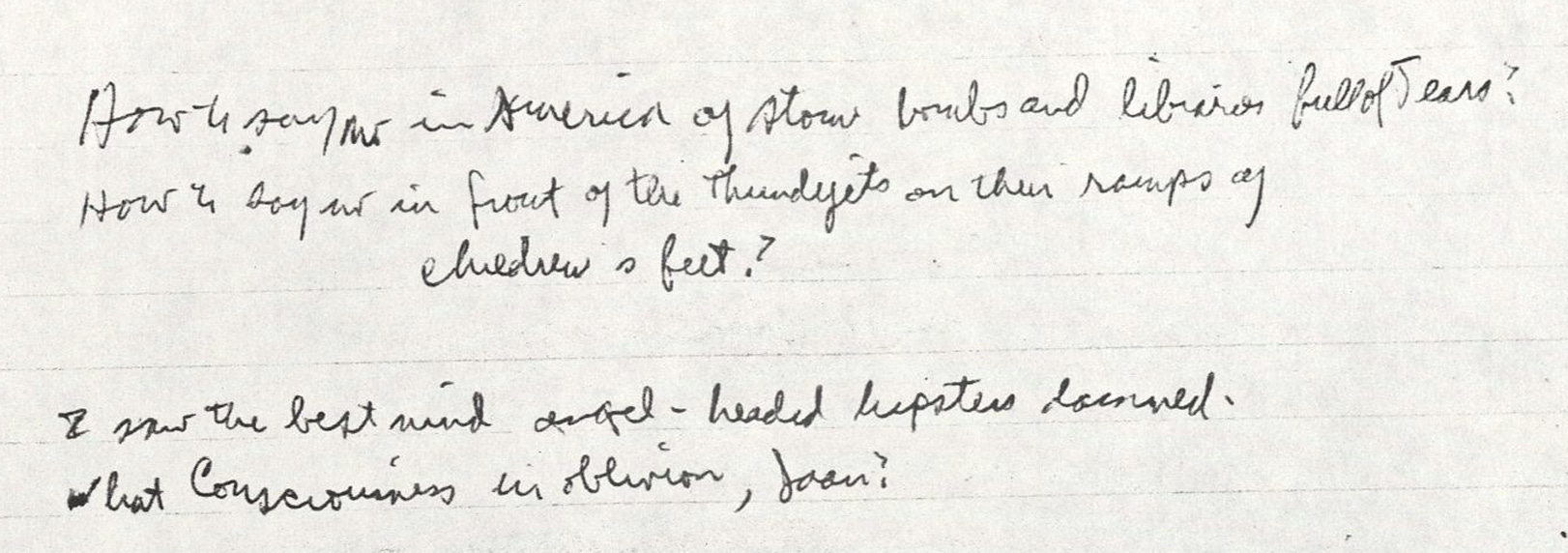
The top two lines read:
How to say no in America of stone bombs and libraries full of tears?
How to say no in front of the thunderjets on their ramps at children’s feet?
It is likely that these lines came to Ginsberg when he was continuing to revise his Joan dream poem and stumbled upon the line “I saw the best minds angel-headed hipsters damned.” Of course, the phrase “libraries full of tears” and the idea of “jets” both appeared in “America,” whilst the “How to say no…” anaphoric repetition (something he played with earlier in 1955) would be morph into “who…” as the start of most lines in Part I of “Howl.”
Is it possible that whilst trying to turn his Joan dream into a poem, he accidentally began work on not one but two of his most famous poems… not to mention the lesser-known ones we have previously discussed? It does rather seem that way. Perhaps I am being presumptuous and drawing connections based on limited evidence, but there is some interesting textual evidence to the contrary. Not only does “The Names” function as a version of “Howl” and draw upon “Dream Record” but it also very clearly includes language used in “America,” and in fact much of this occurs in “Howl” too.
Most obviously, we have the third line of “The Names”:
O America what saints given vision are shrouded in junk their elegy a nameless hoodlum elegance leaning against death's military garage
Although in “America,” he does not use the archaic “O” salutation, he does address his homeland directly, saying for example:
America I’ve given you all and now I’m nothing.
In the above line, we see the words “saints,” “vision,” “junk,” and “death.” These all appear in “Howl” and the first two occur in “America.” He talks about “stone bombs” but in the poem “America,” he mentions the atom bomb. Perhaps this evolved into the “monstrous bombs” and ironically “angelic bombs” of “Howl.” The words “angel” and “angelic” appear through all three poems, as do “God” and “soul.” In all three poems, he makes reference to “jail” and/or “prison,” as well as “judges” and “judging.”
I don’t want to push this too far and certainly many of these words were simply part of his vocabulary that year, but during that intensely creative period he does seem to have had inside him something akin to Burroughs “word hoard”—a collection of ideas and images and poetic concepts and linguistic sets that he struggled for a while to separate. They all seemed connected but thankfully in August he made a start on “Howl” Part I. I think at this point he gave up writing “The Names” (returning a few years later), and by this point “Dream Record: June 8, 1955” was more or less finished and definitely a separate work. In November, he began writing “America.” These were successful efforts and each took him in a very different direction in terms of theme and style, with “The Names” remaining somewhere lost between them. I think it remained important to him as a project begun to recognise the suffering of certain people and he refused to give up on it even after its various ideas had been more successfully employed elsewhere.
Thus, we can conclude that Ginsberg woke up from a dream one night and made a note in his journal that he managed to turn into at least six works that would later appear in his Collected Poem:
Dream Record: June 8, 1955
Howl
America
The Names (aka “Fragment 1957”)
Fragment 1956
·The Names II
And to think that when I wake up in the middle of a strange dream I just close my eyes and go back to sleep…
It is fascinating to me that all of these works have a single shared origin and overlap thematically and lexically. Comparing them can help us to understand his development as a poet but perhaps more importantly they can be used as references for each other to help date his work during that period when he saved everything and dated little.
Footnotes
[1] Most texts refer to the “Six Gallery” but in fact the numeral form was originally used and the founders preferred this. The 6 Gallery was where Ginsberg first read “Howl” on October 7, 1955.
[2] In spite of the square brackets, this is not a later edit or addition. This is exactly what he wrote in his journal. I’ll also note here that I’ve written this essay in British English, so I used “dreamt” in the main text, but Ginsberg typically wrote in American English (although he enjoyed certain British spellings) and so he’s used “dreamed” in his journal.
[3] Interestingly, he wrote “four,” then scored it out to write “five.” Joan Vollmer died in September 1951 and Ginsberg wrote this in June 1955, a little less than four years later.
[4] A note for those who wish to probe this issue further: Ginsberg’s writing here has been inaccurately transcribed where it appears in Journals Mid-Fifties. The differences are minor but it is worth observing due to the importance of this poem. Clearly he cared a lot about each tiny change and so it does seem unfortunate that certain phrases are rendered very differently.
[5] His notes on Williams here are interesting and indeed one could argue that fundamentally the resulting poem was modelled on “The Red Wheelbarrow.” Perhaps it no surprise, then, that two years later he showed some poems to Williams, who expressed particular enthusiasm for “Dream Record: June 8, 1955.” [Letter to Gary Snyder]
[6] At some point in June, Ginsberg began using “July” in his journal but he was referring to events from late June. Again, Journals Mid-Fifties gets this wrong, so if you are following this discussion with that book in hand, keep in mind that the editor has attempted to put passages in the correct order but has taken several false references from Ginsberg’s erroneous dates. We can see from correspondence that he was on a trip with Peter Orlovsky in late June and early July, for example, but he dates this as late July in his journal.
[7] If you have the journal, skip to the page titled “October 26, 1952.” This is where he writes his entry for what is presumably June 5, 1955.
[8] As an interesting aside, this was where John Allen Ryan and the other five founders of the 6 Gallery went to school (five were students and one (Jack Spicer) was a teacher). It was one of the great creative hubs of the city and many of the artists whose work hung in the 6 Gallery, King Ubu, or on the walls of The Place and other cafés and bars studied or taught at C.S.F.A. The school encouraged radical experimentation, hired brilliant teachers, and its campus was unusually beautiful. More on this in my forthcoming book on the 6 Gallery reading…
[9] Another note for those following with the aid of Journals Mid-Fifties: The editor has made some creative choices that have re-arranged these notes. He has clearly attempted to bring some chronological coherence and also to streamline Ginsberg’s poetic discussions. Whilst this makes it more readable, it also obscures the real process of turning the dream notation into a poem. He has also not realised that Ginsberg got certain dates wrong, writing “July” instead of “June” for example. The events described, such as a trip to Yosemite, can be verified against correspondence, showing these happened late June and early July.
[10] I will mention here that Ginsberg was corresponding with John Allen Ryan in Mexico around this time (end of June). Ryan had left San Francisco for a six-month stint in Mexico. He sent Ginsberg several poems but Ginsberg only seems to have sent him one: “Siesta in Xbalba.” I had hoped perhaps he sent a copy of “Dream Record: June 8, 1955” given Ryan was next to him when he had the dream and was mentioned in the first line.
[11] Oddly, Ginsberg read the poem with “Lucien” in it during a 1985 recording. A typed manuscript from around 1957 also shows that he still had “Lucien” in place rather than “Kenney.” When the poem was published in December 1956 in i.e. Cambridge Review, it also included “Lucien.”
[12] One example of him using “paragraph” rather than “stanza” comes from an undated letter but written on Towne & Oller stationery, indicating early 1955.
[13] John Kingsland, a former boyfriend of Joan Vollmer, had been mentioned in the journal entry but was removed, perhaps because he held relatively little significance for Ginsberg. Perhaps he was swapped out for Huncke, whom Ginsberg wished to celebrate.
[14] This seems to be Carl Solomon. The name Leroi obviously brings to mind LeRoi Jones and Ginsberg admittedly uses the word “spade” here, a hip term for black people at that time. He hugely expanded the poem later after getting to know LeRoi Jones, so possibly it is meant to be the latter. However, in his early version he explicitly mentioned Solomon and referred to his “fatness” and repeats that in the expanded version. He also talks about Carl/LeRoi being in a madhouse.
[15] Note: “angel-headed hipsters” was temporarily rendered as the much less effective “hipsters with angelic heads” in the first draft and relegated to a much later part of the poem.
[16] This comes from an unpublished journal fragment. He seems to have rewritten several lines in different ways, so I have pared it down to the basics rather than include pointless repetition.
[17] There seem to be other parts of this introduction re-used in “Howl.” He talks about “locomotives” and “graves” in a line that appears to be a re-written version of the one above.
[18] This reading was recorded and is the first known recording of Ginsberg although at least one other was made in late 1955. It can be purchased from Omnivore Records.
[19] Ginsberg kept pushing and even in 1960 was trying to get Ferlinghetti to publish “Dream Record: June 8, 1955.”
Endnotes
[i] Kenneth Rexroth collection, PCMS-0102. The Poetry Collection., Subseries 1A: A-Z 1853-1979 (bulk 1950-1975) box 8, folder 1 Ginsberg, Allen. 1939-1965.
[ii] Allen Ginsberg papers, M0733. Dept. of Special Collections, Stanford University Libraries, Stanford, Calif., S2 B5 F6
[iii] Allen Ginsberg papers, M0733. Dept. of Special Collections, Stanford University Libraries, Stanford, Calif., S2 B5 F6
[iv] Allen Ginsberg papers, M0733. Dept. of Special Collections, Stanford University Libraries, Stanford, Calif., S2 B5 F6
[v] Allen Ginsberg papers, M0733. Dept. of Special Collections, Stanford University Libraries, Stanford, Calif., S2 B5 F6
[vi] He used the former expression often. One such example is in conjunction with the latter—less common—term and this can be found here: https://allenginsberg.org/2013/06/spontaneous-poetics-84-christopher-smart/
[vii] Allen Ginsberg papers, M0733. Dept. of Special Collections, Stanford University Libraries, Stanford, Calif., S2 B5 F6
[viii] Ginsberg, Allen, Collected Poems 1947-1980, Perennial Library: 1984, p.124
[ix] Allen Ginsberg papers, M0733. Dept. of Special Collections, Stanford University Libraries, Stanford, Calif., S2 B5 F6
[x] Ball, Gordon (ed.), Journals: Mid-Fifties: 1954-1958, Viking: 1995, p.136
[xi] Ginsberg, Allen, Collected Poems 1947-1980, Perennial Library: 1984, p.124
[xii] Allen Ginsberg papers, M0733. Dept. of Special Collections, Stanford University Libraries, Stanford, Calif., S2 B5 F6
[xiii] Allen Ginsberg papers, M0733. Dept. of Special Collections, Stanford University Libraries, Stanford, Calif., S2 B5 F6
[xiv] Kenneth Rexroth collection, PCMS-0102. The Poetry Collection., Subseries 1A: A-Z 1853-1979 (bulk 1950-1975) box 8, folder 1 Ginsberg, Allen. 1939-1965.
[xv] Morgan, Bill, and Stanford, David, Jack Kerouac and Allen Ginsberg: The Letters, Viking: 2010, p.302
[xvi] Morgan, Bill, and Stanford, David, Jack Kerouac and Allen Ginsberg: The Letters, Viking: 2010, p.303
[xvii] Morgan, Bill, and Stanford, David, Jack Kerouac and Allen Ginsberg: The Letters, Viking: 2010, p.304
[xviii] Morgan, Bill, and Stanford, David, Jack Kerouac and Allen Ginsberg: The Letters, Viking: 2010, p.307
[xix] Ginsberg, Allen, Collected Poems 1947-1980, Perennial Library: 1984, p.176
[xx] New York Times, April 23, 1949, Section BUSINESS FINANCIAL, Page 30
[xxi] Kenneth Rexroth collection, PCMS-0102. The Poetry Collection., Subseries 1A: A-Z 1853-1979 (bulk 1950-1975) box 8, folder 1 Ginsberg, Allen. 1939-1965.
[xxii] Allen Ginsberg papers, M0733. Dept. of Special Collections, Stanford University Libraries, Stanford, Calif., S3 B6 F33
[xxiii] Ginsberg, Allen, Collected Poems 1947-1980, Perennial Library: 1984, p.177-178
[xxiv] Ginsberg, Allen, Howl: Original Draft Facsimile, Transcript & Variant Versions, Fully Annotated by Author, with Contemporaneous Correspondence, Account of First Public Reading, Legal Skirmishes, Precursor Texts & Bibliography, Harper Perennial Modern Classics, 2006, p.xii
[xxv] Morgan, Bill (ed.), The Letters of Allen Ginsberg, Da Capo, 2008, p.323
[xxvi] Allen Ginsberg papers, M0733. Dept. of Special Collections, Stanford University Libraries, Stanford, Calif., S2 B5 F6
[xxvii] Allen Ginsberg papers, M0733. Dept. of Special Collections, Stanford University Libraries, Stanford, Calif., S3 B6 F33
[xxviii] Ginsberg, Allen, Collected Poems 1947-1980, Perennial Library: 1984, p.129
[xxix] Allen Ginsberg papers, M0733. Dept. of Special Collections, Stanford University Libraries, Stanford, Calif., S3 B6 F33
[xxx] Ginsberg, Allen, Collected Poems 1947-1980, Perennial Library: 1984, p.128
[xxxi] https://allenginsberg.org/2024/02/t-f-1-2/
[xxxii] Leyland, Winston, Straight Hearts’ Delight: Love Poems and Selected Letters, Gay Sunshine Press, 1980, p.157
[xxxiii] https://allenginsberg.org/2016/12/allen-ginsberg-reading-baltimore-1978-1/
[xxxiv] Allen Ginsberg papers, M0733. Dept. of Special Collections, Stanford University Libraries, Stanford, Calif., S3 B6 F33
[xxxv] Allen Ginsberg papers, M0733. Dept. of Special Collections, Stanford University Libraries, Stanford, Calif., S3 B5 F32
[xxxvi] Dowden, George, A Bibliography of Works by Allen Ginsberg, City Lights Books, 1971, p.220
[xxxvii] Morgan, Bill (ed.), The Letters of Allen Ginsberg, Da Capo, 2008, p.270
[xxxviii] Morgan, Bill (ed.), The Letters of Allen Ginsberg, Da Capo, 2008, p.270
[xxxix] Gifford, Barry (ed.), As Ever: The Collected Correspondence of Allen Ginsberg & Neal Cassady, Creative Arts Book Company, 1977, p.207
With very long essays like this, the endnote system gets glitchy on Substack. If anything has gone missing or if it looks like there is a mistake, let me know and I'll try to manually fix it.