
Review: Giving Myself Away
Adventures on the fringes of the counterculture with Lew Welch.

Allow me to commit a reviewing faux pas by quoting from the introduction to Charles Upton’s recent autobiography (of sorts), Giving Myself Away: From Beat Generation Protégé to Metaphysical Social Critic:
I have constructed this book not only as a personal history but as a cultural chronicle and critique of mass psychology—because I had to understand what was going on in myself, in the world around me and in the attitudes of the people I met if I wanted to save my life. […] it is a testament from the counterculture wing of the Baby Boom, demonstrating how our generation did its best to actualize the mass of potential we were born with in the three disciplines of Art, Religion and Politics, and punctuated by various meetings with remarkable and often famous men and women in each of these arenas.
I have quoted rather than summarised because that is a pretty accurate assessment of what Upton has attempted and succeeded in doing. He acknowledges that he was not fully immersed in many of the movements he describes. “I’ve always lived on the outer edges of different worlds,” he tells us. “So the edge is where I lived—I always have. At the edge of the grammar school and high school worlds, the edge of the Beats, the edge of the Hippies, the edge of Leftist politics, the edge of the New Age; at the edge of the poetry scene, the edge of the Perennialists,” and so on.
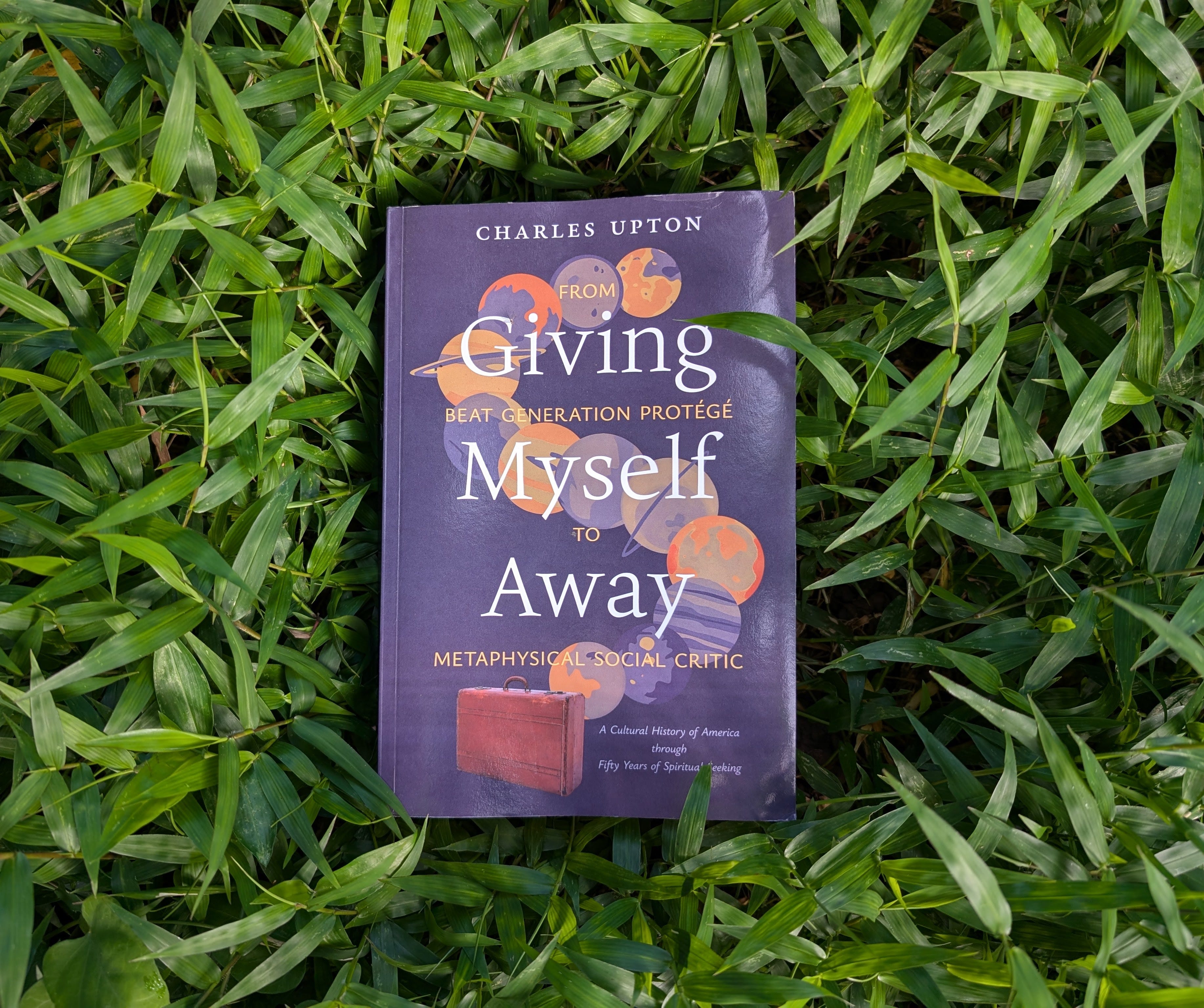
It is these observations from the edges of various mid-20th-century movements that the readers of Beatdom may find interesting. These are mostly found in chapters called “The Planet of Lew Welch and the Beat Generation” and “The Hippie Planet” but they are not confined entirely to these sections. This is very much a poet’s book, an autobiography that is not wholly chronological and features a great many jumps back and forth in time, accompanied by dizzying digressions on all matters historical, poetic, and spiritual. The index is filled with names that readers of this Substack will be interested in and their various appearances can be scattered through other chapters as a sort of free-association, stream-of-consciousness narrative guides the various parts of the book.
Upton, who was born much later than the Beat poets, entered the scene some years after the Beat heyday, but via the familiar channel of City Lights’ Pocket Poets Series. (That was Panic Grass in 1968.) It was Lew Welch who introduced him to many (and possibly most) of the famous people who appear in these pages. He describes meeting Welch here:
And so, in a landscaped garden on the College grounds, complete with a sunken patio and a grove of redwood trees, I met Lew; the only other student was poet Mary Norbert Körte, a Dominican nun in the early stages of leaving the Order, and probably the Catholic Church as well. Unexpectedly, this strange… lean… intense… rawboned… plainly emphatic… deliberately concrete… painstakingly simple man seemed more interested in teaching us perception exercises than in talking about poetry.
Welch taught Upton an idea that he later recognised as the Heart Sutra and told him, “You can be a poet if you want to.” Welch became a mentor to the younger poet and wrote later that Upton was his “only heir.”
Through Welch, Upton met the likes of Allen Ginsberg, Lawrence Ferlinghetti, Robert Duncan, Richard Brautigan, Robert Creeley, Don Allen, Gary Snyder, Gregory Corso, Ed Dorn, Bob Kaufman, Kenneth Rexroth, Jack Hirschman, and Charles Bukowski. There are many others. He admits that he did not get to know most of these people well and some were just very brief encounters but nonetheless it is a hell of a cast of characters and Upton usually offers some interesting insight or observation about each.
He knew Welch best of all and so this is where he has most to say. He writes:
Lew was probably the most philosophical and metaphysical of the Beats, though he his that part of himself in a rather matter-of-fact and simple-minded style of writing—at least to certain ears. I remember when Lawrence Ferlinghetti said to me once, “Welch? He’s just dumb.” He loved truth but hated abstraction—like the Zen people when they warn against “the philosopher disease”—so he labored to render his fundamental perceptions of the nature of reality as concretely as possible, without fanfare, without drama, something like what William Carlos Williams or Gertrude Stein might have done if they had been informed by Dōgen or Lao Tzu.
He knew Welch’s common-law wife Magda Cregg as well and has much interesting information about her. He talks about her experiments with (and smuggling of?) substances such as ibogaine and yagé. He notes that people sometimes accused her of being a magnet for suicidal men, and that she leaned into this by carrying with her one of the world’s most poisonous mushrooms. Calling her a “death-wife” (as opposed to a midwife), Upton says, “Men with suicidal tendencies sought her out so she could ease their passage into the next world.”
Of the Beat poets other than Welch, it is Ginsberg who probably appears the most, although it seems he and Upton did not have a harmonious relationship. He first saw Ginsberg at the Human Be-In—one of many significant events Upton attended and describes in this book. He seems to have had a very pleasant long discussion with Ginsberg but later “he and I developed a kind of low intensity rivalry or general irritation with one another,” Upton writes. Ginsberg dismissed Upton’s poetry as “manic gibberish” and Upton accuses Ginsberg of being rather fraudulent in his Buddhist studies, pretending to meditate whilst in fact taking cigarette breaks every 5 minutes… I was disappointed to see him repeat a false accusation about Ginsberg founding NAMBLA, though. I realise it’s a common mistake but that is precisely why we ought to avoid giving it more credence.
Upton seems to have gotten along better with Whalen and Snyder and has some useful anecdotes about these people and other Beat and hippie figures from that era. These are particularly interesting when relating to spiritual or philosophical matters. There are a few interesting lines about Shig Murao, William S. Burroughs, and Scientology in regards the hippie ethos, and some paragraphs about Sufi Sam and Carlos Castaneda. (There is a loosely made case for Lew Welch being an element of Don Juan.)
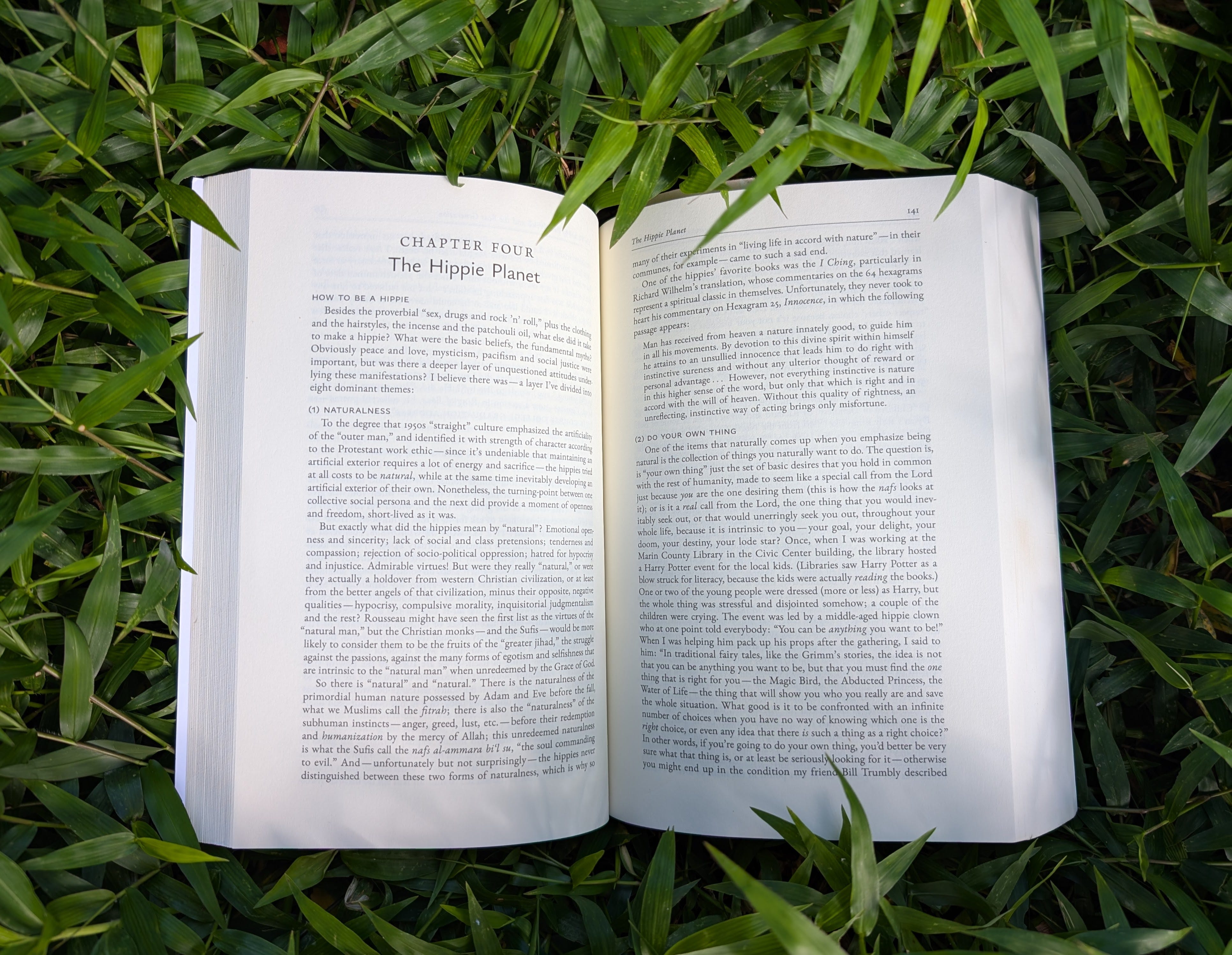
Aside from these walk-on roles from famous people, and his anecdotes and insights about certain Beat figures, the book provides value through Upton’s observations on the shifting values of the eras discussed. Talking about the hippies, he says:
While poetry readings, film festivals and art exhibits were important, the major “art scenes” were the pop music concerts. This was an age when people waited for the next album from one of the major bands (the Beatles, the Who, the Rolling Stones, Bob Dylan, the Band et. al) to identify the next significant changes in group consciousness, tell us what was going on in society, what to identify with, how to confront the future and remember the past, almost who to be. This was the same thing that earlier generations, at least the literary intelligentsia among them, had expected from the major novelists. And the most prominent poets, in the late 60s and early 70s, more-or-less rode on the coattails of the bands.
On the plethora of gurus to whom the hippies flocked, he writes:
There were so many of them, coming from so many different directions, that it became possible (as it were) to practice a different religion every week. This in itself tended to reduce religion to the job of collecting many different spiritual experiences rather than making a commitment to a particular set of beliefs and practices. Rather than doctrine, morality or the work of developing the character and purifying the soul, experience itself became paramount. The religious tripper developed into something like a restaurant or theater critic, “tasting” various spiritual influences, reviewing the and making a list of his or her “favorites.”
He has a useful insight on the transition from the 1960s to 1970s here:
For me and my emerging peer-group, the San Francisco poets, the 1970s was a decade of introversion. The “consciousness” explosion of the ’60s was subsiding, leaving depressing in its wake. Alcohol increasingly became the drug of choice, though not to the degree (heaven forbid) that it crowded out all the other drugs. Feminism was turning a cold fire-hose on the hippie love-fest, generally pooping the party; at the same time that the identity of “poet,” at least for our social sector, was partly replacing the identity of “hippie.” When I first met Lew Welch in the late 1960s, poets were few and far between—a handful of the Beats and a few of their younger protégés, such as myself, John Oliver Simon, David Meltzer, etc. A few years later there were an estimated five thousand poets in the Bay Area, whose collective efforts in the name of self-advertisement—as well as the apparent belief that anyone who knew how to talk was therefore virtually a poet, so serious study of the art of poetry and artistry in the practice of it be damned—was one of the factors that has made poetry almost a hated art in this country.
You will note a slight bitterness (perhaps even bitchiness) there. This is one of the constant negatives in the book. Upton feels the need to constantly remind us of cultural and perhaps civilisational decline. In short: everything is shit now. He could be talking about any part of 20th-century history and suddenly turn to remark upon the evils of wokism and identity politics, or whatever present-day problem has triggered an association in his mind. (I say this as someone who personally agrees with most of his complaints; if you disagree, you may find these insertions more frustrating.)
Even when not bemoaning the state of the world today, this free-association style of writing is both a strength and a weakness. Much of the book is enjoyable and informative, and at times his poetic-spiritual-philosophical asides are very welcome, but there is no getting away from the fact that it is overly long and filled with too many extended digressions. He frequently starts on an interesting path, then takes us via his various personal interests or complaints to a completely different place, then returns approximately to where he was some pages earlier. This conversational style of narrative works well in places but becomes less endearing as the book goes on, particularly as repetition becomes a factor and the chronology becomes jumbled.
Prospective readers should also know that this is—in Upton’s own words—a magical realist memoir. That means it is not just a recounting of memories and opinions centred around what most would consider “the real” but factors such as magic come into play. This may be a positive or a negative depending on the reader. Upton also has a tendency to insert conspiracy theories as facts. Apparently some globalist cabal, perhaps abetted by the “Luciferian” CIA, has been destroying Christianity and family values with the use of LSD...
Overall, I thought this was a good book even if it is overly long and frustrating in its expansive, contemplative, perhaps self-indulgent digressional style. If it were half the length and more focused and organised, it would’ve been an excellent read. As it stands, I would recommend it to those who wish to read more about the parts and persons mentioned above. Upton is an astute observer of the cultural trends he observed from the fringes (and sometimes more closely) during those fascinating decades the book mostly covers. There is much more that my review has not touched upon, including the author’s thoughts on “The Great Naropa Poetry Wars.” You can find it on Amazon or via Bookshop.
On the subject of Lew Welch, readers may be interested in this review of a biography of him that I really enjoyed. It came out in 2023. Jonah Raskin reviewed Upton’s book for Simon Warner’s Substack here.
"Upton feels the need to constantly remind us of cultural and perhaps civilisational decline."
As long as it is well-grounded and not gratuitous, I think we need to be reminded. It has been evident to me for some time that "wokeism" and "identity politics" are in many respects vulgar bastardizations of the ideals that the Beats and their Hippy successors espoused. We need more voices like Upton such that we may begin to connect the dots between the beauty of those ideals and what they meant at the time and how they have essentially devolved and disintegrated into the pathological expressions of self-hatred and special interest that these ideals have become today. There is a certain objectivity to reporting from "the edge" of a subculture that is not afforded to those deeply embedded within it. So this may indeed be a worthwhile read.
---
PS
Speaking of Ginsberg and NAMBLA, I read your article and can understand why you disabled comments. Objectivity in such matters belongs only to a special breed. And so I applaud your efforts, especially in tackling those "grey areas", and find myself largely agreeing with your conclusion.
I also do not believe that Ginsberg physically coerced or emotionally manipulated prepubescent children into non-consensual sex acts. On the other hand, to say this was a spectacular PR blunder by Ginsberg would be an understatement. Ginsberg definitely didn't think this one through, and I think he was several tokes over the line in his pursuit of principles by becoming associated with this reprehensible organization in the name of free speech. Otherwise good people can and do make critical errors of judgement, and this will always taint his legacy.
---
PPS
The discovery of Lew's remains would be quite a find.